
Top 3 alternatives to bonoboai.it 2026

Choosing a platform that efficiently manages data, processes and projects in research and development today is confusing. Many software requires undocumented integrations, offers little pricing transparency, or imposes too rigid flows for teams with different needs. This comparison allows you to decide which specific alternative truly meets the needs of your R&D group.
Index
AI Process Intelligence
In summary
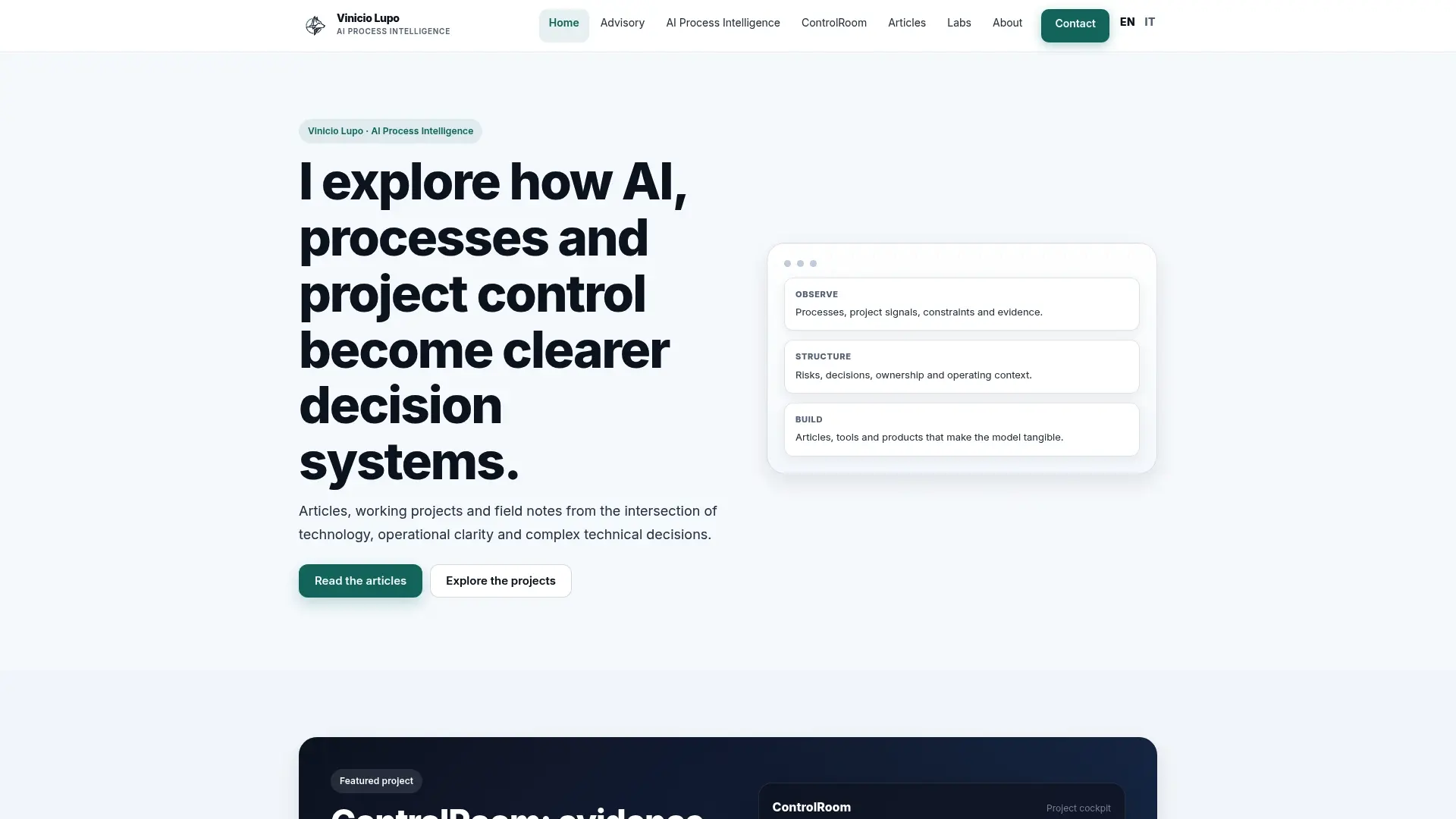
Deterministic calculations traceable to the sourceguide project status assessment and process health measurement. The methodology favors process clarity before introducing automation. This approach translates fragmented flows into maps, scores, Rome and decision dashboards.
Key features
The platform executesprocess mappingto identify steps, managers, systems, data, dependencies and friction points. Measure process health, risk, effort, value and automation readiness with explicit indicators. It generates operational roadmaps with quick wins and strategic plans and offers project control modules for budget, schedule, risk, decisions and performance dashboards.
What sets it apart
The real distinctive element is the combination of deterministic calculations and source traceability with a "structure first" approach. The platform does not start from automation. First structure the processes and quantify risks and value. Only then does it propose automated interventions and operable priorities.
Strengths
The structured approach makes complex processes understandable and measurable, useful for technical and R&D teams. The assessments are based on evidence and deterministic calculations which allow for verification and auditability of decisions. Attention to process clarity reduces premature automation choices and favors pragmatic priorities. Finally, the included tools and experiments help you test hypotheses before implementing solutions.
Weak points
- It requires initial understanding and detailed process mapping, which can be burdensome for teams with poor data or very messy processes.
Who is it aimed at?
It is aimed at technical teams, project managers and R&D groups managing complex initiatives. It is designed for those who have to manage risk, budget and decisions in hardware or multidisciplinary projects. Reading the results presupposes operational skills and the availability of project signals.
Why choose this option
Traceable deterministic calculations allow you to demonstrate how priorities and project health metrics were calculated, making budget and intervention choices transparent. For teams that need to justify technical decisions to stakeholders, this feature reduces subjective discussions. Furthermore, starting from the process structure improves the accuracy of subsequent automations.
Concrete example
A project team uses ControlRoom to collect project signals, risks, and decisions in a single dashboard. Deterministic calculations connect each indicator to the source, allowing for real-time corrections and reprioritization on deliberations.
Prices
Not applicable. The offer is descriptive and informative; There are no rates or business plans published on the site.
Website: https://viniciolupo.com
Balthazar
In summary
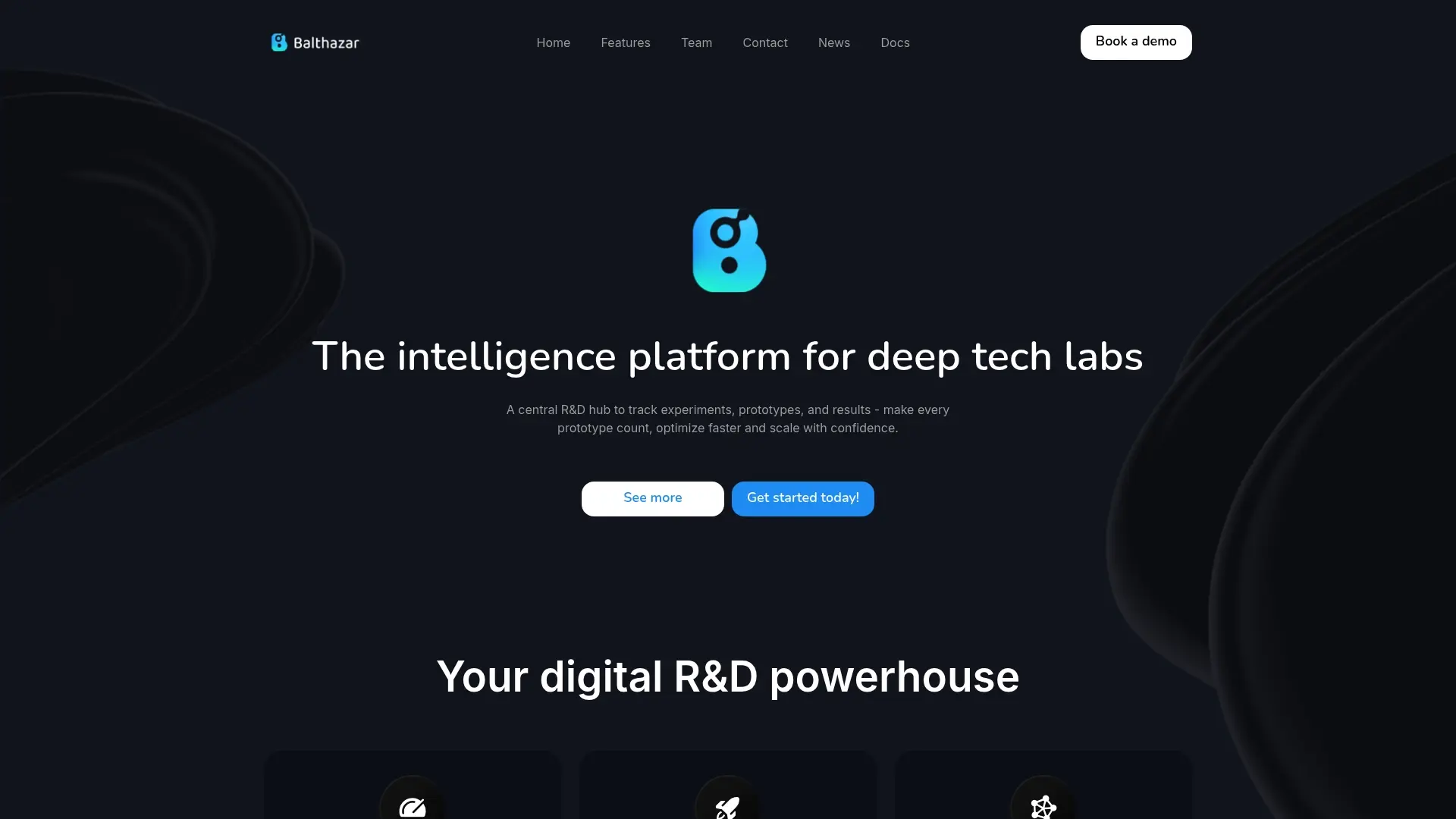
Integrate experimental data with machine learning-driven design tuning into a searchable knowledge repository. The platform automatically captures test and simulation data via Python integrations. It offers real-time dashboards and access controls for highly complex research projects.
Key features
Balthazar organizes aknowledge baseinterconnected that connects prototypes, tests and results in a searchable way. It supports automatic data capture from physical tests and simulations via Python integrations and displays real-time dashboards to compare experiments and KPIs. It also includes shared workspaces with version control for protocols and recipes, and machine learning-driven design tuning tools.
What sets it apart
The feature that really differentiates Balthazar is the direct coupling between experimental data and machine learning processes in a single searchable environment. This brings together tracking, analysis, and experimentation suggestions into a single workflow geared towards deep tech labs. The approach is designed to keep code, measurement data and experimental procedures together.
Strengths
The platform streamlines complex experimental flows by combiningreal-time dashboardand linked experimental logs, reducing the need for separate spreadsheets. Automating data capture reduces manual errors and speeds up decisions thanks to live analytics. The sharing model with role control and comments facilitates collaboration between distributed teams.
Weak points
-
Information about the pricing model is limited on the homepage, so transparency on costs is poor.
-
Third-party integration options are not clearly listed, which complicates assessing compatibility with existing tools.
-
The learning curve can be steep. Small teams or teams with limited technical skills may find adoption challenging.
When it's not suitable
If you lead a small group with minimal IT resources, Balthazar may be too complex. If your priority is a public catalog of ready-to-use integrations, the lack of integration details can be a limitation. If a transparent and immediately comparable price list is needed, the pricing formula probably does not satisfy this need.
Who is it aimed at?
Designed for R&D teams in deep tech labs and high-tech product development groups. It suits project managers, experimental engineers, and data scientists who manage prototypes, recipes, and large test sets. It is suitable for those who require structured experimental tracking and shared knowledge management.
Concrete example
A semiconductor lab uses Balthazar to track thousands of prototypes, tests, and simulations. This allows for faster iteration cycles, better coordination between engineers, and fine-tuning of designs based on collected data. Centralized protocol recording also makes it easier to reproduce tests and analyze variants.
Prices
The site does not specify pricing details. The communication suggests offers tailored to enterprises or laboratories, probably with custom plans based on the number of projects, users and deployment requirements. For a quote you need to contact the vendor.
Website: https://balthazar.app
ViMi
In summary
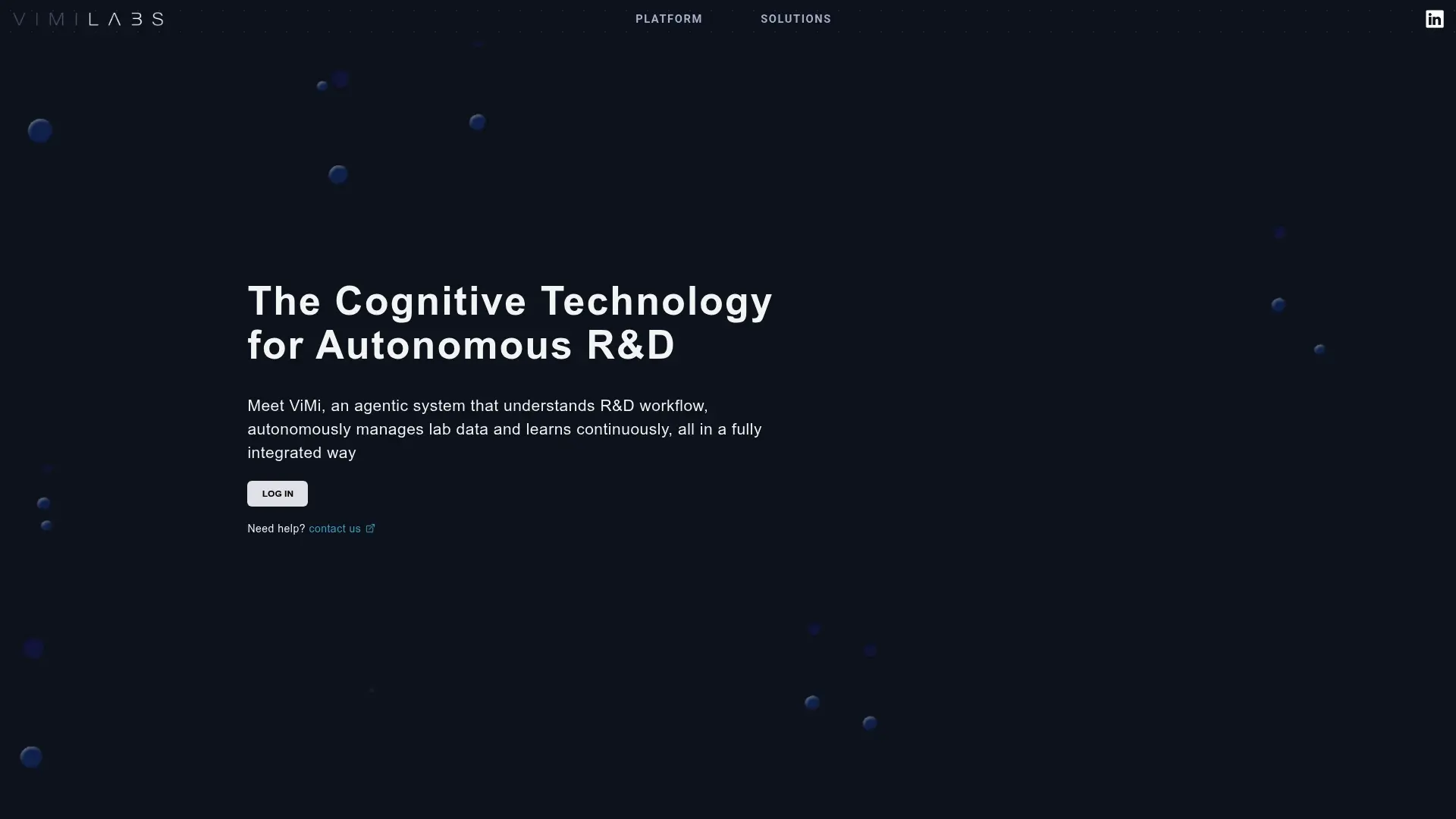
ViMi presents itself as an agent system that continuously learns to connect laboratory data and research workflows on energetic materials. The stated objective is to accelerate the discovery and commercialization of materials thanks to cognitive data analysis. The platform aims to reduce the time between experiment and market evaluation.
Key features
The solution combines data management and artificial intelligence tools to operationalize the experimental flow in the laboratory. Integrate characterization, modeling, and performance results so that data remains usable throughout the entire development cycle.
- Automated knowledge graphsand metadata standards to optimize laboratory workflows.
- Scalable data management for different types of R&D data, including experimental results and simulations.
- AI-enabled tools to extract cognitive correlations between structure and properties.
- Direct integration of characterization, modeling and performance data for cross-analysis.
- Structure-property correlations and tools for production optimization.
- Imaging and characterization with IoT for real-time data collection.
- Decentralized knowledge extraction for collaborative insights.
- Predictive and prescriptive analyticsto support experimental decisions.
- Accelerated synthesis and advanced simulations for materials development.
What sets it apart
The distinctive feature is theautonomous agent systemwhich learns from workflows and coordinates heterogeneous data. This architecture brings together continuous learning and collaboration between institutions. It functions as a link center between experimental characterization and computational modeling.
Strengths
ViMi combines data management and machine learning specifically for materials research, with practical benefits for teams already collecting complex experimental data. Workflow automation reduces repetitive tasks and frees up time for higher-value experiments. Distributed collaboration support facilitates projects with academic and industrial partners. Furthermore, real-time IoT collection allows immediate analyzes on characterization processes.
Weak points
- Limited public information on user interface and operational flows; detailed documentation is not easily found.
- High complexity, with probable need for specialized training to fully exploit the features.
- Details on customization and scalability for different research fields are not clearly listed.
- No list of public integrations available, which can make it difficult to assess fit into the existing IT ecosystem.
When it's not suitable
Small labs or teams without data engineering resources will find it difficult to implement this platform. If you need a plug and play tool for a single project with low data volume, ViMi will be oversized. For research areas not related to energetic materials, support and use cases may require preliminary checks.
Who is it aimed at?
Research organizations and industrial R&D teams working on materials, with a focus on the energy sector, get the most value. Consortia between universities and industry also benefit from decentralized data sharing. It requires digital laboratory skills and the ability to integrate experimental and computational flows.
Concrete example
A consortium of universities and companies uses ViMi to coordinate experiments on battery materials. Centralize characterization datasets and simulations and automate structure-property correlations. The team shortens experimental iterations with recommendations based on predictive analytics.
Prices
The price is not publicly specified. The availability and the commercial model appear to be oriented towards enterprise contracts or partnerships. Contact the vendor for tailored proposals and implementation options.
Website: https://vimilabs.com
Software for managing research and development initiatives
The comparative analysis of the following software highlights their distinctive characteristics and who they are aimed at, to facilitate user decisions.
| Product | Distinctive feature | Intended for | Weak points | Prices |
|---|---|---|---|---|
| Viniciolupo | Deterministic calculations traceable to the source | Technical and R&D teams in complex projects | Initial mapping expensive | Price not published |
| Balthazar | Integration between experimental data and machine learning | Highly complex deep tech laboratories | Limited transparency on costs | Price not published |
| ViMi | Autonomous agent system for energy workflows | Energetic materials research organizations | High complexity for implementation | Price not published |
Which alternatives to bonoboai.it better manage projects and R&D activities?
Many technical teams and project managers are looking for platforms that give an accurate and traceable assessment of project status, with clear tools to manage risks and decisions. Viniciolupo responds to this need by focusing on a "structure first" approach that maps processes and uses deterministic calculations to guide priorities without immediately relying on automation.
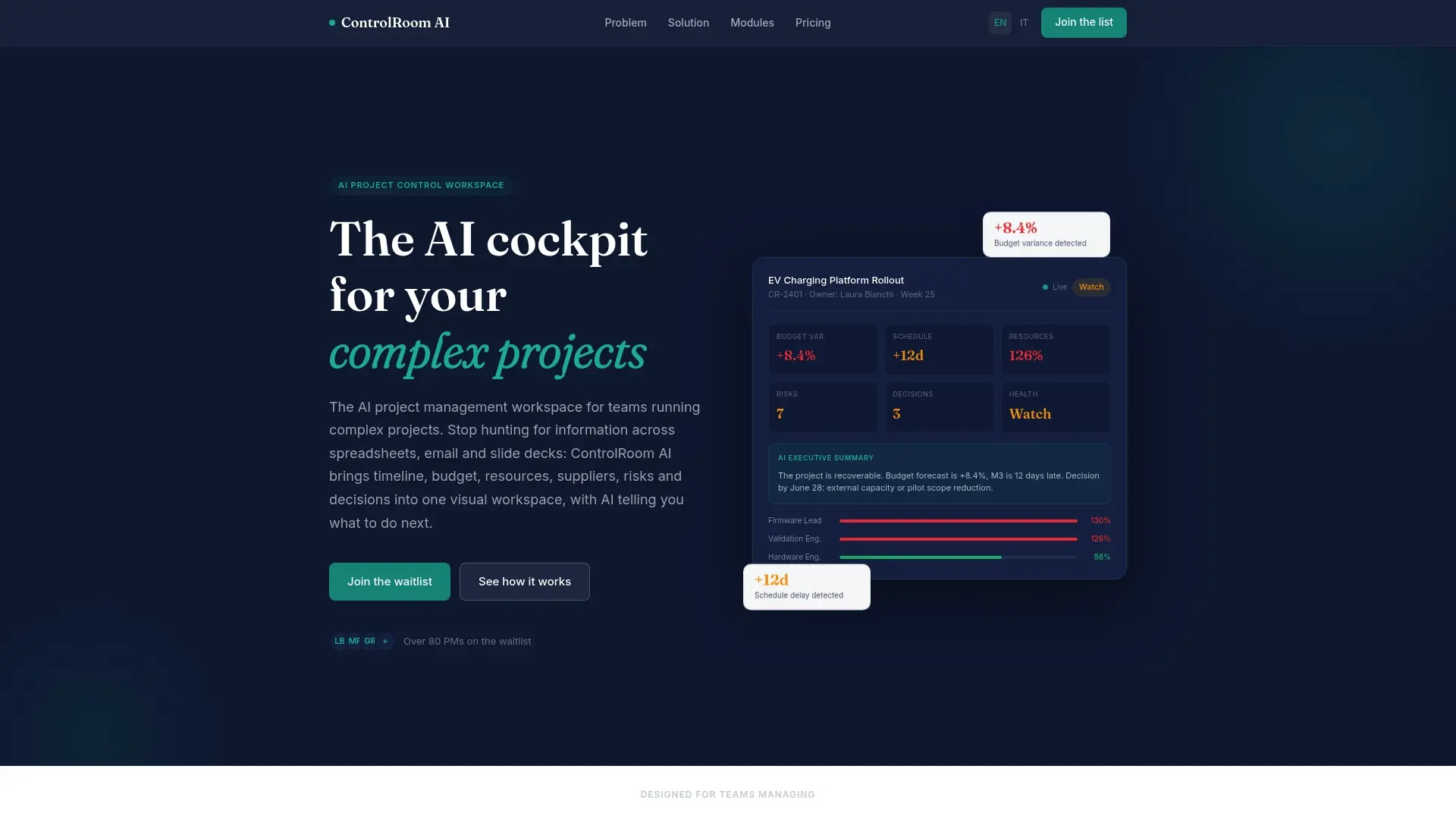
Consider how Viniciolupo can facilitate the control and transparency of R&D initiatives. VisitViniciolupo ControlRoomand try decision-making dashboards specific to teams balancing budget and risk. Import project signals and make every choice based on traceable and verifiable data.
Frequently asked questions
How does Viniciolupo compare to Balthazar in terms of data management?
Viniciolupo offers process mapping that allows the identification of all steps and those responsible. Unlike Balthazar, which integrates experimental data via tools like Python, Viniciolupo focuses on process clarity, facilitating immediate understanding of workflows. This structure is particularly advantageous for teams that want a clear vision of the project without excessive technical complications.
What is the distinctive feature of Viniciolupo compared to ViMi?
ViMi aims to connect laboratory data in an agentic way, continuously learning from workflows. In contrast, Viniciolupo uses source-traceable deterministic calculations to measure process health. This difference makes it suitable for teams that need a solid foundation for evidence-based decisions before automating processes.
What features does Viniciolupo offer to support the management of R&D projects?
Viniciolupo generates operational roadmaps highlighting quick wins and strategic plans, making processes understandable and measurable. This feature is particularly useful for R&D teams that need to track risks and decisions in complex, multidisciplinary projects.
Is Viniciolupo suitable for small teams with limited resources?
Viniciolupo, while a powerful solution, requires a detailed initial understanding of the processes. If your team has very messy processes or little data available, it may be challenging to implement successfully. It is recommended to evaluate pre-existing structures before fully adopting it.
What is Viniciolupo's pricing strategy?
Specific details about Viniciolupo prices are not published on the site. This may require direct contact to obtain adequate information on the customized business model, useful for R&D teams that have specific needs.
Recommended
- Microsoft Project Alternative 2026: Guide for Italian PMOs — ControlRoom AI
- Process Readiness Tool | AI Score for Processes and Automation
- Lab | Trading Monitor and Product Execution
- Articles on AI Process Intelligence, Projects and Automation | Vinicius Wolf