

Communicating technical progress in management means translating the real state of a project into useful information for those who have to decide. In R&D teams, this expertise separates projects that move forward from those that stall due to avoidable misunderstandings.Clear communication channelsthey prevent 86% of organizational misunderstandings. This data indicates that most conflicts in technical projects arise not from technical problems, but from poorly structured communication. An effective technical reporting strategy reduces delays, aligns stakeholders and turns every update into a moment of concrete decision.
How to communicate technical progress to management
Communication of technical progress is not an ancillary activity. It is the backbone of project progress management. Without it, management makes decisions on data that is incomplete or interpreted differently from department to department.
The first requirement is to define dedicated channels for each type of update. One channel for daily team updates, one for the monthly progress report to stakeholders, one for urgent escalations. Mixing these streams leads to confusion and delays.

The second requirement is a shared glossary.The lack of terminology standardsbetween departments is often a source of avoidable conflicts. When an engineer talks about “70% completion” and the project manager means something different, the data loses value. A shared technical glossary, even just one page, eliminates this ambiguity at its root.
Digital tools accelerate internal communication, but do not replace it. Collaboration platforms such as AI project management workspaces centralize updates, comments and documents in one place. This reduces time spent searching for information and increases the traceability of decisions.
Communication skills are as important as tools. The main ones to be developed in the team are:
- Active listening: listen 70% of the timeand talking 30% improves mutual understanding measurably.
- Emotional intelligence:recognize the emotional state of interlocutors before transmitting complex technical data.
- Summary:knowing how to reduce a technical update to three key points for non-technical management.
- Structured feedback:close each update with a specific question, not with a generic "are there any questions?".
A tip: before each progress meeting, send a pre-read of up to one page with the three critical points. Management arrives prepared and the meeting becomes decision-making, not informational.
How to structure reports that facilitate quick decisions
An effective report does not describe the past. It guides future decisions.Predictive reportingtransform meetings into moments of strategic decision, not passive update sessions.
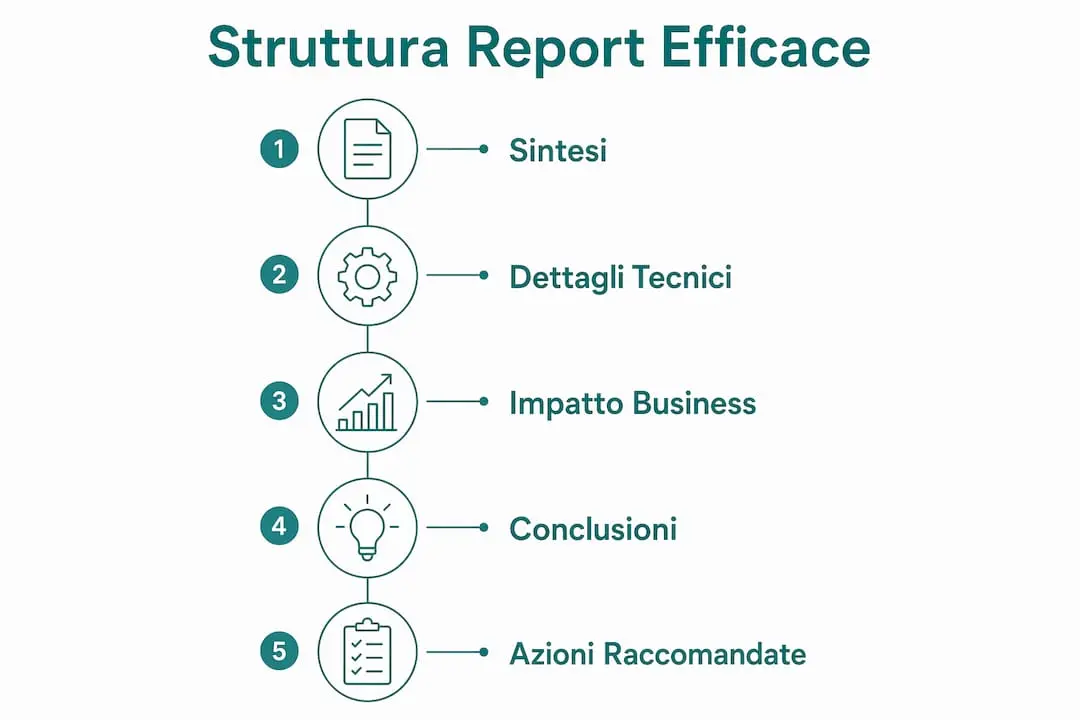
The difference between passive reporting and predictive reporting is concrete. Passive reporting lists what happened. Predictive reporting shows what will happen if you don't take action by a specific date. This distinction changes the behavior of management: from spectator to decision maker.
The winning approach starts from identifying who makes decisions and what information is needed, not from the tool or template. Before building a report, answer this question: what decision should the person reading it make?
The structure of an action-oriented report follows four blocks:
- Executive Summary:three lines describing the current status, the main risk and the recommendation. Whoever reads this alone must understand everything.
- Methodology:how the data was collected and how often.A clear methodologystrengthens the reader's credibility and trust.
- Analysis and visualizations:simple graphs, not tables with 40 columns. A bar graph showing the deviation between planned and actual is worth more than three pages of text.
- Specific recommendations:not "evaluate options", but "approve X's additional budget by Friday to avoid the two-week delay".
The adoption ofdata storytelling in reportsincreases success in data-driven decisions by 75%. This comparison with the 35% of reports without storytelling shows that the narrative format is not an aesthetic embellishment, but a multiplier of decision-making effectiveness.
Adapting the language to the audience is equally crucial. The CTO wants technical details. The CFO wants cost impact. The CEO wants risk and opportunity. The same data must be presented in three different ways to three different interlocutors.
| Audience | Priority information | Recommended format |
|---|---|---|
| Technical team | Implementation details and technical blocks | Structured list with tickets and priorities |
| Project manager | Deviations from plan and critical dependencies | Simplified Gantt with traffic lights |
| Executive management | Risks, costs and decisions required | Executive summary with three points |
A tip: use the inverted pyramid principle: put the conclusion at the top, then the details. Those who have little time read only the first paragraph and still get the information they need.
Strategies to improve collaboration in R&D teams
Collaboration in R&D teams deteriorates when communication is reactive rather than structured. Conflicts almost always arise from unstated expectations, not from technical incompetence.
Transactional analysis is a concrete technique for improving communicative exchanges. It identifies three ego states (parent, adult, child) and teaches how to maintain communication on an adult-adult level, i.e. rational and fact-oriented. Applied in progress meetings, it reduces defensive reactions and speeds up problem resolution.
Developing emotional intelligence in teams reduces internal conflicts by 58% and improves collaboration. This result is achieved with specific training, not with general good intentions.
Escalation management is another often underestimated skill. Many project managers avoid escalating for fear of appearing incompetent. It is the opposite mistake that damages projects.
«Escalation managed strategically by senior stakeholders is a leadership practice, not a defeat. Delaying a necessary escalation is the real defeat."
Defining roles and responsibilities in internal communication prevents inconsistencies.Determine who communicates whatand to whom it is essential to avoid contradictory messages between teams. A simple RACI framework applied to communication, not just tasks, resolves most “I didn't know” conflicts.
The most effective practices for collaboration in R&D teams are:
- Short, frequent alignment meetings (15 minutes a day) instead of long weekly sessions.
- Asynchronous channels for non-urgent updates, with agreed response times.
- Monthly retrospectives focused on communication, not just technical deliverables.
- Soft Skills Training: A 400% ROI within 12 months makes this investment hard to ignore.
For thestakeholder managementin complex projects, defining a dedicated communication plan for each interest group reduces surprises and maintains alignment over time.
How to measure the effectiveness of project communication
Measuring communication is possible and necessary. Without metrics, you don't know if your strategies are working or if you're just adding noise.
Quantitative metrics to monitor include: number of unplanned escalations per month, average response time to critical updates, percentage of decisions made within expected time after a report. These figures show whether communication produces concrete actions.
Qualitative metrics are collected with short post-meeting surveys, quarterly focus groups and internal documentation audits. A single question, such as "did this update give you the information to decide?", provides a clear signal on the effectiveness of technical reporting.
Creating communication dashboards allows you to monitor qualitative and quantitative indicators to improve communication governance. A dashboard does not have to be complex: three or four indicators updated weekly are enough to identify trends and intervene before problems become crises.
| Metric | Like | Detection frequency |
|---|---|---|
| Unplanned escalations | Quantitative | Monthly |
| Post-meeting satisfaction | Qualitative | After every key meeting |
| Decisions made within deadline | Quantitative | Weekly |
| Perceived clarity of updates | Qualitative | Quarterly |
Continuous improvement requires a structured cycle: collect data, analyze patterns, change one element at a time and measure the effect. Changing everything at once makes it impossible to understand what worked.
Key points
Structured communication of technical progress reduces misunderstandings, accelerates decisions and transforms reporting from a formal obligation to an active governance tool.
| Point | Details |
|---|---|
| Dedicated channels by update type | Separating daily flows, monthly reports and escalations avoids confusion and delays. |
| Shared technical glossary | Standardizing terms across departments eliminates the main source of avoidable conflicts. |
| Decision-oriented reports | Each report must contain an executive summary, methodology, analysis and specific recommendations. |
| Emotional intelligence in the team | Training your team on soft skills reduces conflicts by 58% and generates an ROI of 400%. |
| Communication metrics | Monitoring escalations, response times and post-meeting satisfaction allows you to improve over time. |
Information governance is the real unsolved problem
I've worked with dozens of R&D teams that had excellent tools and documented processes. The problem was never technology. It was that no one had decided who was responsible for communicating what, to whom, and how often.
The most common mistake I see is confusing communication with information. Sending a report does not mean communicating. Communicating means that the recipient understands, has the information to decide and knows what is expected of him. This distinction seems obvious, but in practice it is systematically ignored.
Predictive reporting is the skill that separates mediocre project managers from effective ones. It is not enough to describe where we have arrived: we must show where we will arrive if we do not intervene. This requires courage, because it means exposing risks before they become visible problems.
Another thing I learned: communication training in technical teams should be done with examples taken from their real work, not with generic exercises. An engineer who learns to structure a technical update using data from his current project changes behavior in weeks, not months.
The evolution of communication skills in R&D teams is not a linear path. There are regressions, resistances and moments when the team reverts to old habits under pressure. The key is to make structured communication the easiest way, not the most laborious.
— Vinicio
Viniciolupo for communication and monitoring of projects
Viniciolupo has developed specific tools for those who manage complex technical projects and need to communicate progress in a clear and traceable way.
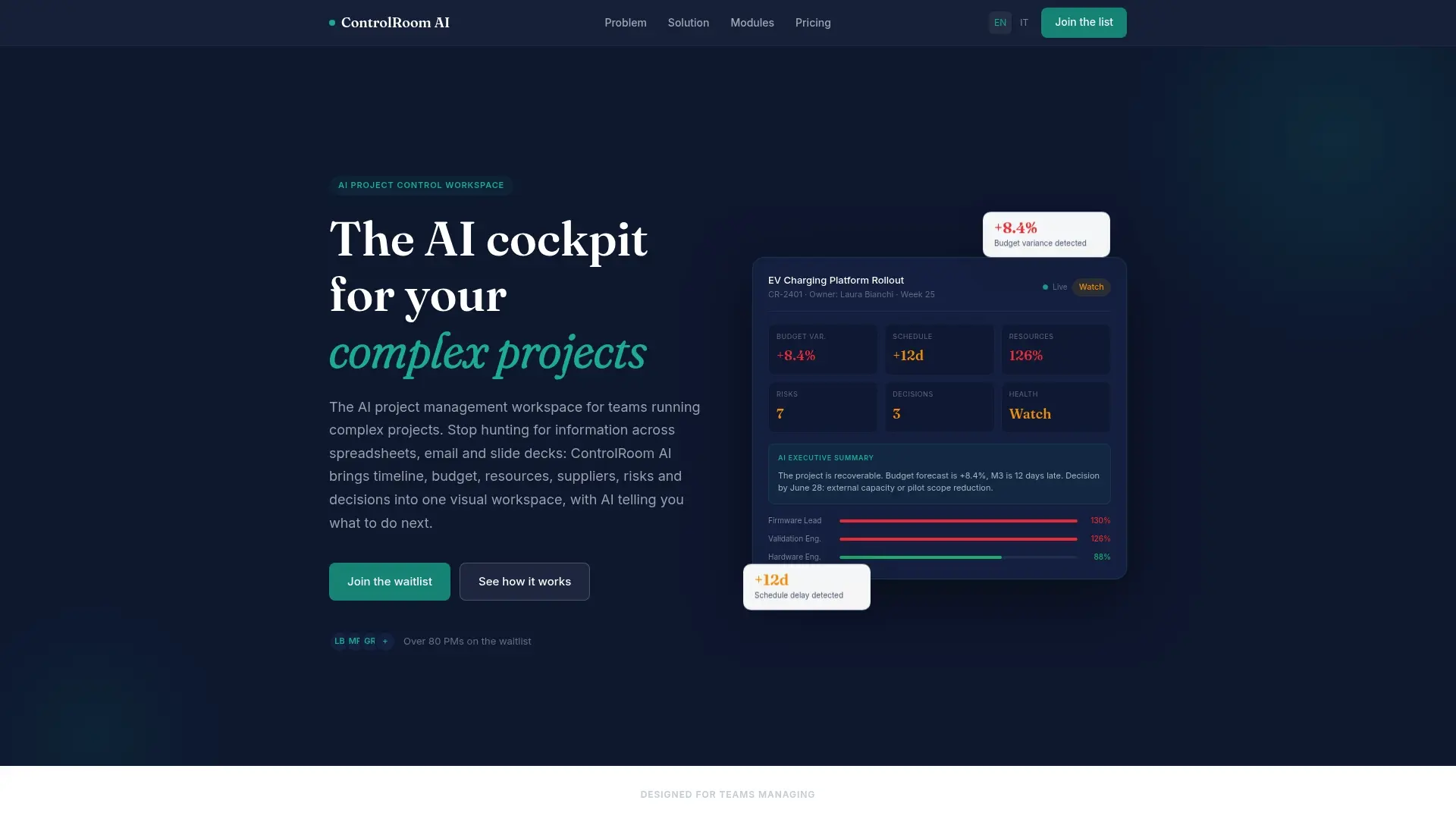
ControlRoom AIis the AI project management workspace designed for Italian R&D teams and PMOs. Centralize updates, documents and decisions in a single environment, with integrated predictive reporting capabilities. For those who want support on more complex technical decisions,AI Process Intelligenceoffers tools to analyze processes, identify bottlenecks and translate technical data into understandable recommendations for management. Both solutions are designed to reduce the time spent in information meetings and increase the time dedicated to decisions.
Frequently asked questions
What is technical progress communication?
Technical progress communication is the process by which a team translates the status of a project into useful information for stakeholders and management. The goal is not to inform, but to enable timely decisions.
What tools improve technical reporting in R&D teams?
AI-powered project management workspaces centralize updates and documents, reduce information leakage, and support decision-oriented predictive reporting.
How is the effectiveness of project communication measured?
Unplanned escalations, response times to critical updates, and post-meeting satisfaction are measured. These three indicators provide a reliable picture of the quality of internal communication.
Why is the shared technical glossary so important?
The lack of terminology standards between departments generates avoidable conflicts. A shared glossary aligns the meaning of key terms and reduces ambiguity in reports and meetings.
What is the ideal structure of a progress report?
An effective report includes executive summary, methodology, analysis with clear visualizations, and specific recommendations. The executive summary must be self-sufficient: those who read only that must understand the status of the project and the decision required.