

The digitalisation of project management is the application of digital processes and software to make the coordination of corporate projects in Italy more efficient and transparent. This transformation concerns both large companies and SMEs, and in 2026 it took on a precise regulatory dimension: the MIT guidelines (approved in February 2026) and the UNI 11337-8 standard (published in April 2026) frame digital information management in public works, alongside the BIM obligation set by the Procurement Code. Adopting digital tools is no longer an optional choice for those working on public procurement. For private teams, however, it represents the most direct way to reduce bottlenecks, improve collaboration and keep budgets and deadlines under control.
What are the concrete advantages of digitalisation in project management?
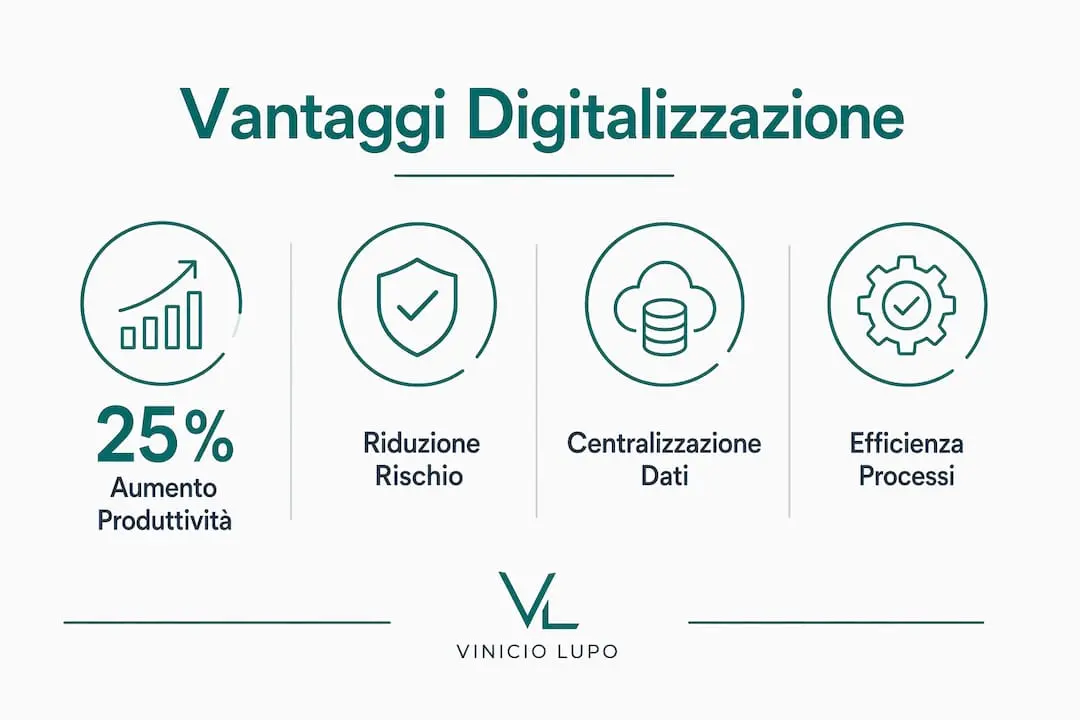
Adopting centralized project management software can reduce alignment meetings, lost emails and decisions made without the right information; how much depends on the team and is not quantified here.
A CRM connected to project management can help for a simple reason: when clients, tasks and deadlines live in the same digital environment, the team spends less time searching for data scattered across spreadsheets or email threads.
The main benefits of digitalisation for Italian project teams are:
- Real-time visibilityon the progress of each activity, without having to call update meetings.
- Reduction of downtimebetween one phase of the project and another, thanks to the automation of notifications and assignments.
- Budget controlmore precise, because hours worked and costs are recorded automatically.
- Asynchronous collaborationbetween teams distributed across multiple locations or in hybrid mode.
- Traceability of decisions, with a history that can be consulted by all project members.
The least mentioned benefit, but often the most relevant, is risk reduction. When each task has a person responsible, a deadline and a visible status, problems emerge sooner and are resolved with less damage.
Which digital tools to use for project management in Italian SMEs?
The choice of tool depends on the size of the team, the complexity of the projects and the available budget. There are three main categories of digital project management software.

Project management software
These tools manage tasks, deadlines, dependencies, and resources. They are suitable for teams that coordinate multiple projects in parallel. The simplest systems use Kanban views or task lists. More advanced ones include Gantt charts, portfolio management and automatic reporting.Visual tools like Kanbanthey are preferable for teams that manage daily tasks rather than complex systems, because they lower the learning curve and increase real adoption.
Integrated CRM and ERP
A CRM connects customer management with project management, avoiding data duplication. An ERP goes further: it integrates accounting, human resources, purchasing and production into a single system. ERP costs span a very wide range, from cloud solutions to customized on-premise implementations. That gap reflects a real difference in complexity: SMBs rarely need the most expensive version. Request current quotes from vendors before comparing options.
| Category | Suitable for | Complexity |
|---|---|---|
| Basic project management | Team of up to 20 people | Low |
| Advanced project management | PMO and multiple teams | Average |
| CRM with project module | Customer-oriented companies | Average |
| Cloud ERP | Structured SMEs | High |
| On-premise ERP | Big companies | Very high |
A tip: Before evaluating software, define the number of projects active at the same time and the number of people involved. These two parameters immediately narrow down the unsuitable options.
The Italian SMEs that are lookingfree tools to get startedthey can test basic solutions before committing to an annual subscription.
How to start an effective digitalization of project management
Going digital fails when companies replicate inefficient processes in new software. Mapping and simplifying existing processes before digitizing is the prerequisite that is most often skipped, and which most often causes project failure.
An effective approach follows these steps:
-
Map current processes.Document how the management of a typical project works today: who does what, when, with which tools and with which information. This exercise often reveals redundant passages that no one had ever questioned.
-
Delete before scanning.Any activity that does not add value should be removed from the workflow before transferring it to a digital system. Digitizing an inefficient process only makes it quicker to produce bad results.
-
Choose a tool with a low learning curve.Many SMEs abandon tools that are too complex. A software used at 30% of its functionality produces less value than a simpler one used at 100%.
-
Involve the team in planning the change.Theactive involvement of teamsin the choice and configuration of tools, the adoption rate significantly increases. Whoever participated in the decision does not sabotage the result.
-
Trained on the why, not just the how.Resistance to change is the real obstacle to digitalization. Training that only explains how to use software does not solve the problem. We need to explain why the old method didn't work and what concretely changes for each person.
-
Proceed in stages.Thedigitalization must be gradualand calibrated to the real capabilities of the organization. Start with a single team or type of project, measure results and then scale adoption.
A tip: Designate an “internal champion” for each team: a person who knows the tool well and answers questions from colleagues. This reduces the burden on the IT department and accelerates adoption.
For teams who want to evaluate their level of preparation before starting, Viniciolupo offers areadiness assessment toolto digital processes.
How Italian legislation influences the digitalisation of projects
The Italian rules on digital project management do not only concern the construction sector. They define a reference model that applies to any organization that wants to structure its information management in a verifiable way.
From 1 January 2025, it is mandatory for public bodies to adopt BIM methods for works exceeding 2 million euros. This obligation directly concerns contracting and granting authorities, but indirectly involves all SMEs working as subcontractors or service providers on these projects.
The normUNI 11337-8:2026takes the concept of BIM to a higher level: digitalization evolves into a Digitalized Process Management System, known as SGPD. The SGPD is not just about 3D models of buildings. It defines how an organization collects, manages and shares information throughout the life cycle of a project.
| Regulatory reference | Scope | Obligation or recommendation |
|---|---|---|
| MIT 2026 Guidelines | Public bodies, procurement | Guidance on applying the Code (approved February 2026); the obligation itself comes from the Procurement Code, for works above 2 million euros |
| UNI 11337-8:2026 | Construction and real estate | Reference standard for SGPD |
| Procurement Code (Legislative Decree 36/2023) | Public procurement | Regulatory basis for the BIM obligation |
For private SMEs, the SGPD is not yet mandatory. Adopting it voluntarily, however, improves internal governance and makes the company more competitive in public tenders.
The adoption of complex systems without adequate organizational structure risks being counterproductive. The legislation itself recommends a calibrated approach: first build organizational capacity, then implement the tools.
Key points
The digitalisation of project management in Italy requires clean processes, tools calibrated to the company size and training that explains the why of the change, not just the how.
| Point | Details |
|---|---|
| Map before digitizing | Eliminating inefficient processes before transferring them to software avoids automating errors. |
| Choose the right tool | A simple software used at 100% is worth more than an advanced one used at 30%. |
| Train on why | Resistance to change is overcome by explaining the concrete benefits for each person, not just the functions of the tool. |
| Know the regulations | From 2025, the BIM obligation for works above 2 million euros also involves SMEs working on public contracts. |
| Proceed in stages | Gradual adoption, starting with a single team, reduces risk and allows you to measure results before scaling. |
Cultural transformation comes before technology
Imagine a team that purchases expensive software and abandons it within a few months. The cause may well not be the tool, but the fact that no one explained to the team why the old way of working no longer worked.
Thedigital transformation is first of all cultural. This is not an abstract concept. It means that a project manager who continues to manage everything via email, even after adopting new software, ruins the entire investment. And he does it because no one has given him a convincing reason to change his habit.
A mistake to avoid is choosing the tool before understanding the problem. You buy an ERP because "everyone uses it", without asking yourself whether the company really needs to integrate accounting and production into a single system, or whether good project management software with a reporting module would be enough.
My practical advice: start with the most painful problem. Where do your projects waste the most time or money? Start there, choose the simplest tool that solves that specific problem, and build from there. Agile methodologies teach exactly this: iterate starting from what works, don't plan everything in advance.
Well-designed digitalization doesn't just make work easier. It changes the way a team makes decisions, and that is the most lasting competitive advantage.
— Vinicio
Viniciolupo and the digital management of complex projects
Teams managing complex projects, with many dependencies and multiple stakeholders, need more than just a simple task manager. Viniciolupo has developedControlRoom AIto respond to this specific need: an AI work environment for managing technical and research and development projects.
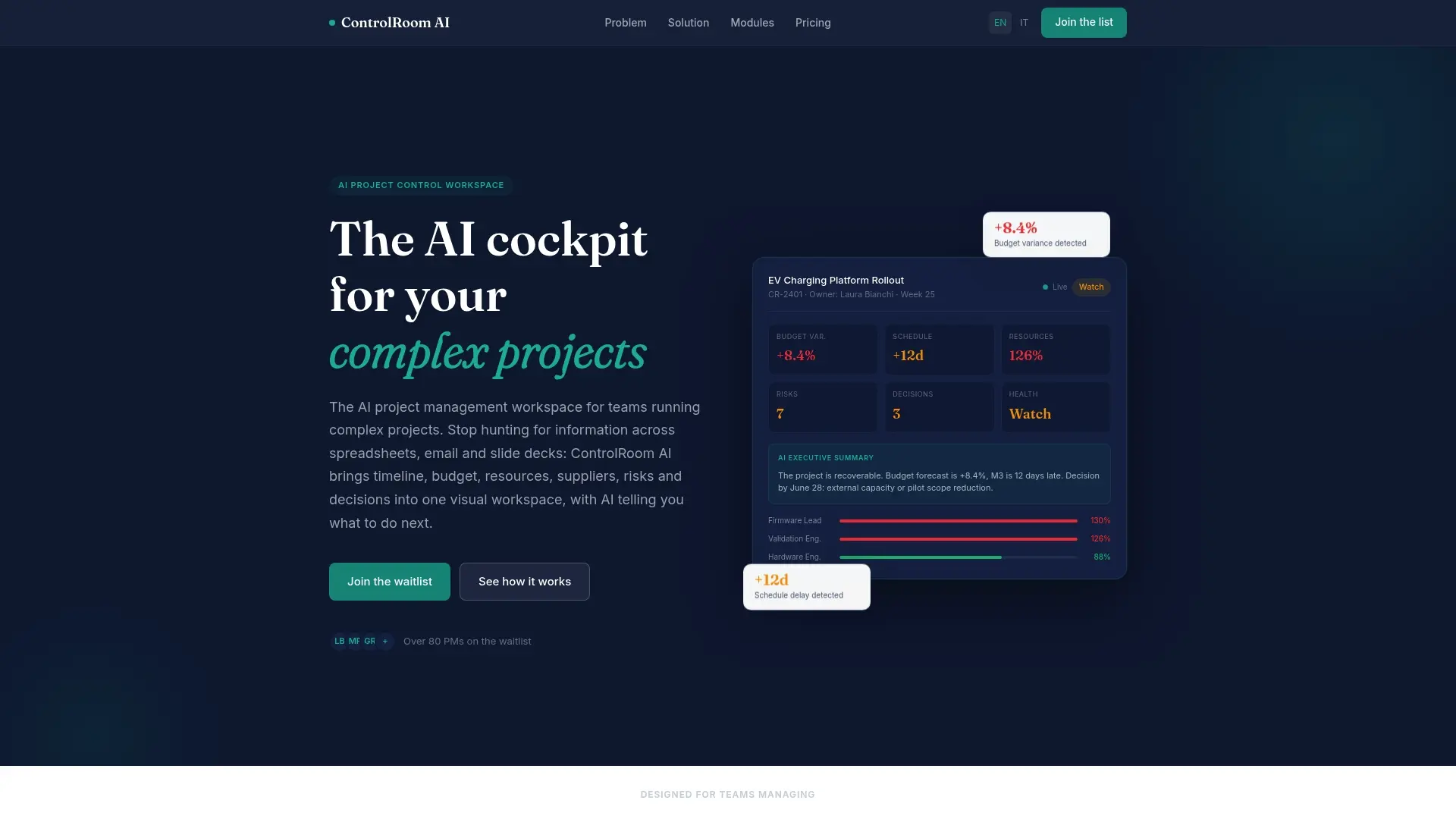
ControlRoom AI is designed to bring plan, costs and issues of complex projects into one view. For Italian teams who want to see whether the solution fits their context, the demo form gives access to a demo environment with synthetic data. Theinsights into AI and automationavailable on the site help to understand where artificial intelligence can bring real value in project management, without generic promises.
Frequently asked questions
What is the digitalisation of project management?
Project management digitalization is the adoption of digital software and processes to plan, coordinate and monitor project activities more efficiently and transparently than traditional methods.
Which digital tools are most suitable for Italian SMEs?
Italian SMEs benefit more from project management software with a visual interface, such as those based on Kanban, which have a low learning curve and encourage real adoption by the team.
Does the BIM obligation also apply to private companies?
From 1 January 2025, the BIM obligation applies to public bodies for works exceeding 2 million euros. Private companies are not obliged, but adopting the UNI 11337-8:2026 standard improves competitiveness in public tenders.
How much does it cost to implement an ERP system for project management?
There is no single figure: cost depends heavily on scope, from cloud solutions to customized on-premise implementations. Request current quotes from vendors. SMEs generally find the best balance between functionality and cost in cloud solutions.
Why do many companies fail to digitize projects?
The most frequent reason is to digitize inefficient processes without first simplifying them. A second reason is to choose tools that are too complex that the team abandons after a few weeks to return to previous methods.