

Project management with artificial intelligence is defined as the integration of automation, predictive analysis and real-time decision support within the life cycle of a project. This approach surpasses traditional management methods on one decisive point:automation reduces bureaucratic burdenby 30–40%, freeing the project manager for strategic activities. For R&D teams and Italian managers who today compare consolidated methodologies and AI solutions, the question is no longer "if" to adopt AI, but "how" to do it without losing control of the process. The CPMAI framework and ethical governance principles offer a structured response to this challenge.
What are the limits of traditional project management in modern contexts
Static planning is the most serious limitation of traditional management methods. A Gantt plan built at the beginning of the project reflects the assumptions of that moment: when requirements, suppliers or business priorities change, the plan becomes obsolete before it is even approved.
The main problems focus on three areas:
- Responsive Tracking:the PM detects problems after they occur, not before. Weekly progress meetings capture the past, not the future.
- High bureaucratic burden: up to 40% of the timeof a project manager goes into repetitive tasks such as status updates, transcriptions and manual reporting. This time taken away from leadership is a hidden cost that no project budget quantifies.
- Poor adaptability:methodologies such as classic Waterfall assume stable requirements. In an R&D context where discoveries change the direction of the project every week, this rigidity generates delays and rework.
- Retrospective risk management:risks are identified in registers at the start of the project and rarely updated. The result is a false feeling of control.
The accelerated digital transformations of recent years have made these limits even more evident. An R&D team working on products with short development cycles can't afford to wait until the monthly steering meeting to learn that a critical supplier is behind schedule.
A tip: Before evaluating any AI solution, map your PM's activities over the past four weeks. If more than 30% of your time went into reporting and manual updates, you already have the answer as to why to change.
How artificial intelligence transforms project management
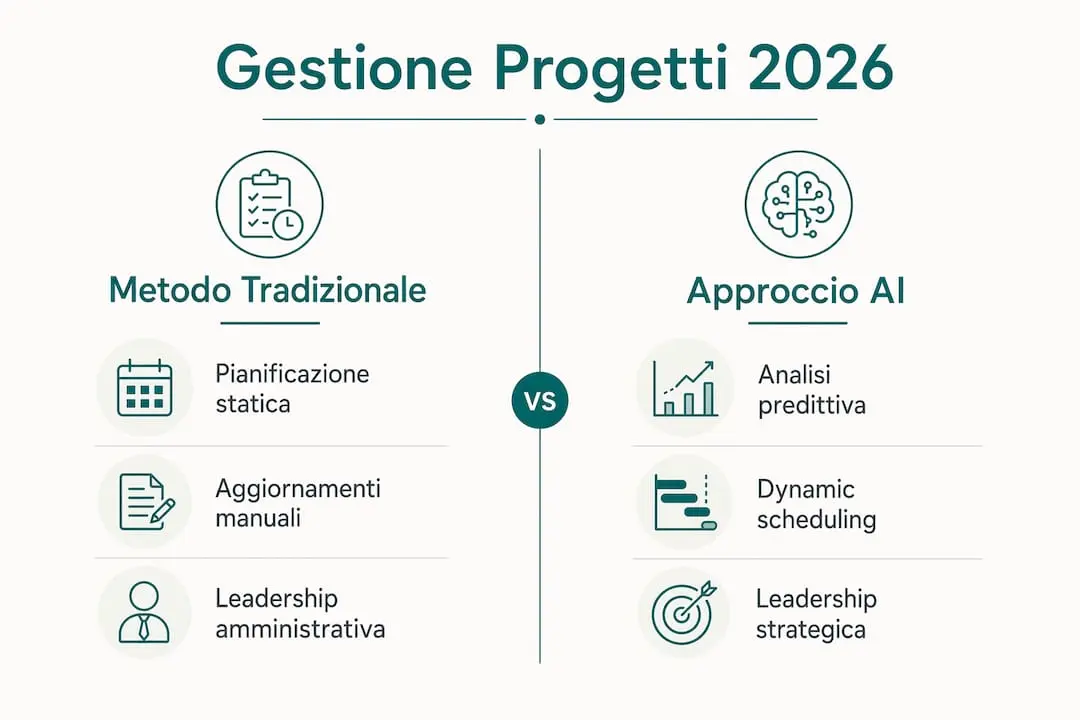
AI doesn't improve project management: it redesigns it. The capabilities it brings are qualitatively different from any previous automation.
The four main transformations are:
- Automation of repetitive tasks. AI systems automatemeeting transcripts, Gantt chart updates, and generating progress reports. The PM receives a structured summary instead of producing it.
- Real-time adaptive planning.Dynamic scheduling automatically recalculates the impact of a delay on all dependent activities. If a supplier delivers three days late, the system updates the plan and flags critical activities within seconds.
- Continuous risk monitoring.Early warning systems identify anomalies based on historical patterns, detecting weak signals invisible to traditional monitoring. Governance shifts from reactive to predictive.
- Decision support with what-if analysis.The PM can simulate alternative scenarios in real time: "what happens if we move this milestone by two weeks?" AI calculates the impact on costs, resources and contractual deadlines.
| Capacity | Traditional method | AI approach |
|---|---|---|
| Plan update | Manual, weekly | Automatic, continuous |
| Risk identification | Static registry | Predictive early warning |
| Reporting | Produced by the PM | Automatically generated |
| Scenario analysis | Limited, slow | Real-time simulations |
A tip: Don't implement dynamic scheduling on all projects at the same time. Choose a pilot project with sufficient historical data and use it to calibrate system parameters before expanding adoption.

What are the main challenges and barriers to the adoption of AI in project management
The main obstacle is not technologybut the lack of methodological bases and skills to use it effectively. This is the point that most organizations underestimate when planning AI adoption.
The concrete barriers are:
- Data quality.Poorly managed data generates unreliable predictions. An AI system trained on incomplete or inconsistent project data produces worse output than a well-maintained Excel sheet. Before any implementation, an audit of the quality of historical data is needed.
- Cultural resistance.Teams accustomed to consolidated processes perceive AI as a threat to their role. This resistance slows adoption more than any technical issue.
- Specific skills.Certified training is a precondition for return on investment. The CPMAI (Cognitive Project Management for Artificial Intelligence) framework provides a methodological framework for managing AI projects with built-in governance, risk management and stakeholder alignment.
- Black-box effect. Ethical governance and transparencythey are essential to prevent teams from uncritically accepting AI outputs without understanding them. The European AI Act imposes explainability requirements that R&D teams must already consider when choosing tools.
- Focus error.Without reorganizing processes, focusing only on tools amplifies existing problems instead of solving them. AI applied to a dysfunctional process produces dysfunctions faster.
For Italian R&D teams, the additional challenge is the fragmentation of data between different systems: ERP, laboratory instruments, document management platforms. Without integration, AI works on a partial vision of the project.
How to effectively integrate AI and traditional methods for innovative project management
The hybrid model is the most effective answer for organizations that cannot or do not want to abandon consolidated processes. Integration occurs through progressive levels of automation, not with an immediate radical change.
Levels of progressive automation
The first level automates low-value tasks: transcriptions, status updates, report generation. The second level introduces predictive risk monitoring and dynamic scheduling. The third level, the most mature one, brings strategic decision support with what-if analysis and scenario simulations.
This progression allows the team to build trust in the AI's outputs before entrusting it with critical decisions. It is also the surest way to identify where data is insufficient or where processes need to be redesigned before automation.
The redefined role of the project manager
The PM evolves from administrative controller to strategic leader. This change is not automatic: it requires active training and an explicit redefinition of responsibilities. PM with AI handles exceptions, interprets ambiguous signals and maintains alignment between business objectives and technical outputs. Routine work is done by the system.
CPMAI framework as a structured guide
The CPMAI framework integrates governance, risk management and stakeholder communication in a specific approach for AI projects. For Italian R&D teams, this framework offers a common language between the technical function and company management, reducing misunderstandings about expectations and results.
You can learn more about AI integration methodologies inarticles on AI Process Intelligenceof Viniciolupo, where you will find specific application cases for Italian industrial contexts.
A tip: use the CPMAI not as a bureaucratic checklist but as a conversation map with stakeholders. Each section of the framework answers a question that management will ask sooner or later: who decides, who controls, what happens if the AI makes a mistake.
For those who want to evaluate the maturity of their processes before investing, theProcess Readiness Toolby Viniciolupo provides a rapid diagnosis of the level of organizational readiness.
What concrete benefits does AI bring to the R&D team and company management
The benefits of AI in project management are measurable and focus on four areas:
- Reduction of bureaucratic burden.Automation frees up 30–40% of the project manager's time. For an R&D manager managing three or four projects in parallel, this equates to recovering almost two working days a week to dedicate to technical decisions and supplier relations.
- Predictive risk management.Early warning systems identify anomalies before they become problems. An R&D team developing a new material can receive an alert when experimental data shows a deviation from expected patterns, not when the delay is already established.
- Superior decision-making quality. The collaboration between human and artificial intelligenceproduces more informed decisions. The PM brings context and judgment; AI brings the ability to process large volumes of data in real time.
- Resilience and adaptability.R&D projects are inherently uncertain. An AI system that continuously updates the plan based on real experimental results reduces the impact of surprises and accelerates team realignment.
Key data:70% of organizations are already using AI in at least one project process in 2026. Companies that have not yet started a structured experimentation risk accumulating a backlog that is difficult to fill.
Key points
Project management with AI surpasses traditional methods because it transforms governance from reactive to predictive, frees the project manager from bureaucratic burden and produces more informed decisions in real time.
| Point | Details |
|---|---|
| Limitation of traditional methods | Static planning does not hold up in volatile contexts: problems emerge after they have already occurred. |
| Main benefit of AI | Automation frees up 30–40% of the PM's time to focus on leadership and strategic decisions. |
| Critical barrier to adoption | Data quality and methodological training (CPMAI) are prerequisites, not options. |
| Recommended integration model | Progressive adoption by levels of automation reduces risk and builds trust in AI outputs. |
| Role of the project manager | The PM becomes a strategic leader who interprets signals and handles exceptions, not an update administrator. |
AI as a co-pilot: my vision for project management in 2026
I have seen many Italian organizations approach AI with two opposite attitudes: uncritical enthusiasm and total distrust. Both produce the same mediocre results.
The truth I have observed in the field is more uncomfortable: AI amplifies what already exists. If your project processes are disorganized, AI will make them disorganized faster. If your team doesn't know what they want from the project, AI will generate detailed reports on the wrong objectives.
The real value lies not in the tools but in the change of mentality they impose. When an AI system tells you that a risk has a high probability of materializing, you are forced to decide: act now or wait? This pressure towards proactive decision making is the most underrated benefit of the entire category.
For R&D teams, I add a specific observation: your designs are probabilistic by nature. AI is the only tool that manages uncertainty in a structured way instead of pretending it doesn't exist. A traditional Gantt lies. A dynamic scheduling system with early warning tells you the truth, even when it's inconvenient.
Training remains the unresolved issue. I've seen companies invest in expensive platforms and then not use them because no one had the expertise to interpret the outputs. The CPMAI is not bureaucracy: it is the way to avoid wasting the investment.
AI does not replace the project manager. It replaces the part of the job that a human should never have done.
— Vinicio
Viniciolupo and ControlRoom AI for project management
Viniciolupo has developedControlRoom AIas a native work environment for managing complex projects, with a specific focus on R&D teams and highly variable contexts. The platform automates recurring manual tasks, generates real-time progress reports, and integrates predictive risk monitoring directly into the PM's workflow.
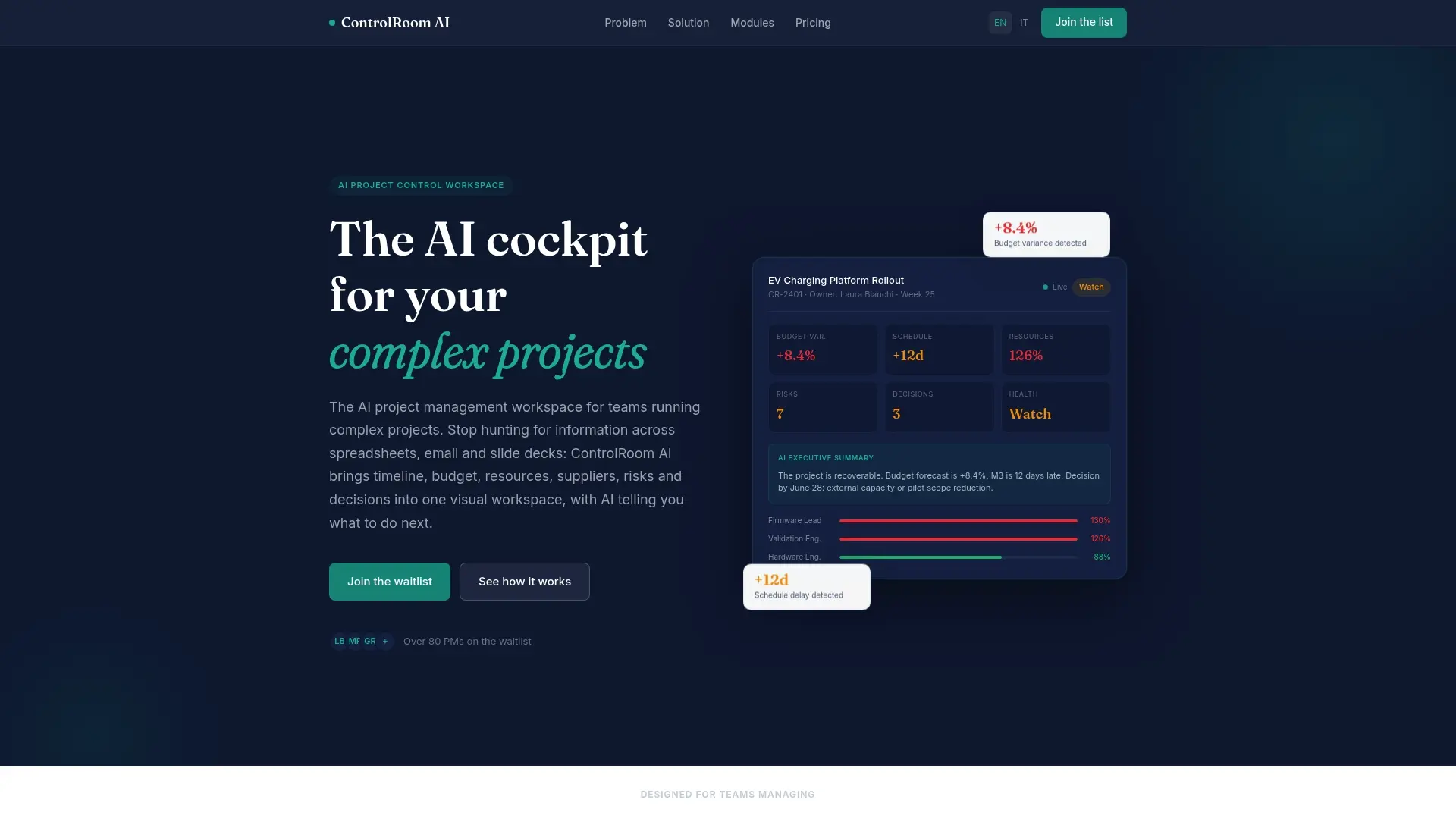
ControlRoom AI connects to your organization's existing technology stack, eliminating the need to replace existing systems. For teams managing complex technological decisions in R&D, Viniciolupo also offers aR&D decision-making consultancyto clarify integration choices before committing to an investment. Anyone who wants to evaluate their current abilities can start fromfree toolsavailable on the site.
Frequently asked questions
What is AI project management?
AI project management integrates automation, predictive analytics, and real-time decision support into the project lifecycle. It reduces the PM's bureaucratic burden and transforms governance from reactive to predictive.
Which traditional management methods are most affected by AI?
Static planning methodologies such as Classic Waterfall are the most limited in dynamic contexts. AI dynamic scheduling overcomes them because it automatically recalculates the impact of each variation on the overall plan.
What is the CPMAI framework and why is it needed?
CPMAI (Cognitive Project Management for Artificial Intelligence) is a methodological framework that integrates governance, risk management and stakeholder alignment for AI projects. It provides the necessary structure to avoid the black-box effect and ensure compliance with the European AI Act.
How long does it take to integrate AI into project management?
There is no standard time: it depends on the quality of existing data and organizational maturity. An approach for progressive levels of automation, starting from repetitive activities, produces measurable results in a few months without high risks.
Does AI replace the project manager?
No. AI eliminates bureaucratic burden and supports decisions, but strategic responsibility and relationship management remain human. The PM becomes a leader who interprets signals and handles exceptions, not an update administrator.