
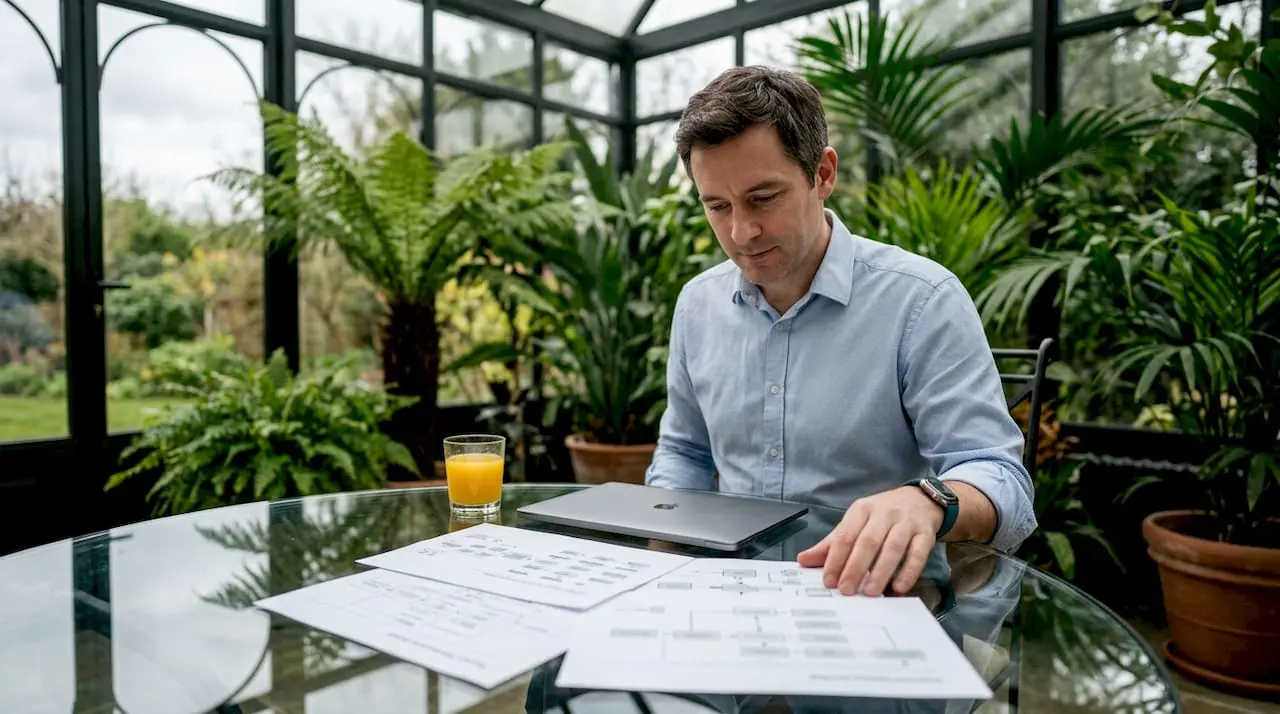
Waterfall is a sequential project management model with comprehensive planning defined before launch, while Agile is an iterative framework that delivers value in short cycles while adapting to changes. Understanding what the waterfall vs agile project is is not a theoretical question: the wrong choice between these two project methodologies can compromise time, costs and quality of the final result. In 2026, with the growing complexity of IT and R&D projects, the distinction between the two approaches remains the starting point for any serious management decision.
What is waterfall vs agile project: main features
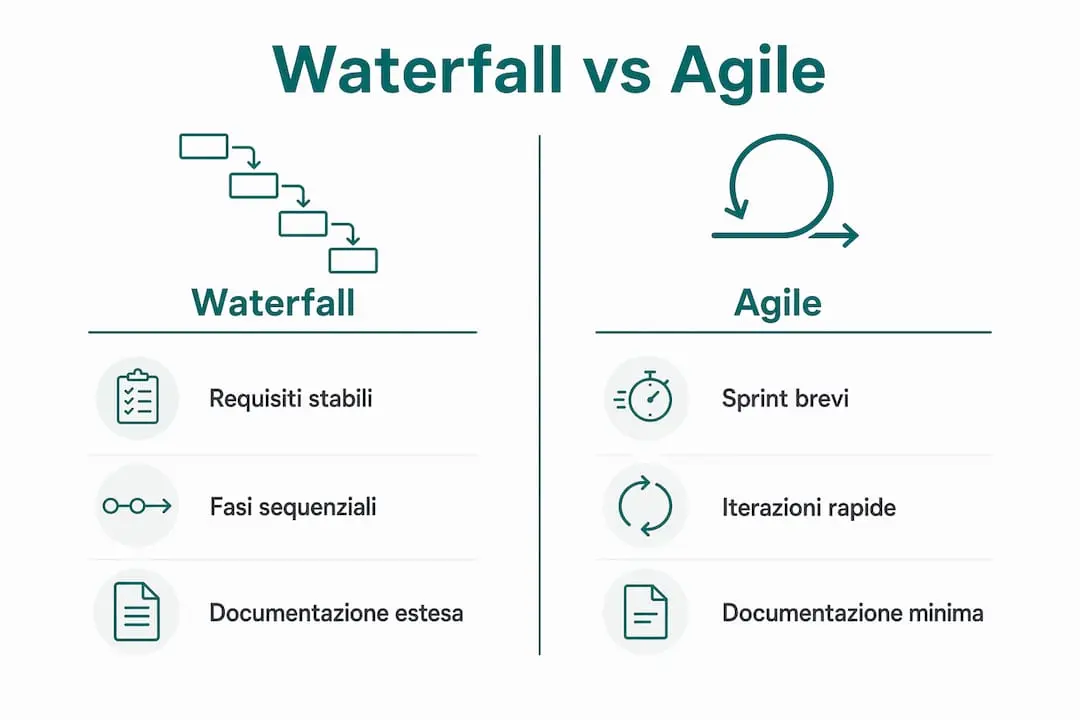
Waterfall organizes the work in strictly sequential phases: requirements gathering, design, development, testing and release. Each phase must end before the next begins. TheWaterfall model requires 100% of the requirementsdefined in advance, which guarantees rigorous control over times and costs but leaves little room for adjustments along the way.
Agile works the opposite way. Work is broken down into 2–4 week sprints, each with defined goals, review and feedback. The team delivers working increments of the product every cycle, allowing the customer to see real results well before the final release. This is agile development explained in its essence: continuous iteration instead of monolithic planning.

Team roles and structure
In Waterfall the project manager coordinates phases and resources with centralized authority. The documentation is extensive and formal, necessary to track every decision and justify every deviation. In Agile the team is self-organized: figures such as the Product Owner and the Scrum Master distribute decision-making responsibility. Documentation in Agile is minimal but functional, oriented towards value delivered rather than bureaucratic coverage.
Change management
Waterfall manages changes through formal change request processes, which slow down execution and increase costs.In Agile, feedback is integrated into every sprint: change is not an exception to be managed, but an expected component of the process. This makes Agile particularly suitable for contexts where requirements evolve during the project.
A tip: Before choosing your methodology, map your project requirements on a scale from “fully defined” to “yet to be explored.” The closer you get to the second extreme, the more Agile becomes the natural choice.
What advantages and disadvantages do Waterfall and Agile have?
Waterfall offers predictability. With stable requirements and clear regulatory constraints, the model ensures a detailed plan that every stakeholder can read and approve before launch. This clarity is a real advantage in industries such as infrastructure construction, defense or regulated healthcare, where deviating from the approved plan has legal or security consequences.
The main limitation of Waterfall is structural: errors hide until the final testing phase. Defects discovered only during the testing phase can consume a huge portion of the budget, because they require reopening already closed phases. This is the risk that managers often underestimate when they choose Waterfall for organizational convenience rather than for real suitability to the context.
The advantages of the agile method focus on the ability to reduce risk by distributing it over time. Every sprint produces a verifiable result: if something doesn't work, the team finds out after two weeks, not after twelve months. TheStakeholder involvement is continuous in Agile, while in Waterfall it is limited to the main milestones. This directly impacts the final customer satisfaction.
Agile has its limits, however. It requires available and responsive stakeholders: without regular feedback, sprints lose effectiveness. It also requires a mature team, capable of self-organizing without constant supervision. In the absence of these conditions, Agile produces chaos, not agility.
- Waterfall: strengths.Comprehensive planning, document control, suitable for stable requirements and regulatory contexts.
- Waterfall: weak points.Late discovery of errors, high costs of modification, poor adaptability.
- Agile: strengths.Continuous feedback, incremental release, risk management distributed over time.
- Agile: Weaknesses.Dependence on team maturity, need for involved stakeholders, difficulty in estimating total costs.
In which contexts should you choose Waterfall, Agile or a hybrid approach?
Themethodological choice depends on three criteria: requirements stability, stakeholder availability and time-to-market urgency. Evaluating these three factors before starting a project drastically reduces the risk of having to change course mid-execution.
When to use Waterfall
Waterfall works when the requirements are defined and will not change. Typical contexts include:
- Projects with strong regulatory constraints, such as medical systems, critical infrastructures or certified software. Waterfall's extensive documentation meets audit and compliance requirements.
- Projects with fixed budget and defined scope, where the client cannot or does not want to actively participate during execution.
- System migrations with complete technical specifications, where each component is already mapped and the risk of variation is low.
When to use Agile
Agile is the right choice when requirements are partial or expected to evolve. Typical contexts include:
- Development of new digital products, where the market provides feedback that changes priorities during the project.
- Research and development projects, where technical uncertainty is high and solutions emerge during execution.
- Team with available and responsive stakeholders, capable of participating in sprint reviews with quick decisions.
The hybrid approach as a modern best practice
70% of IT projects use a hybrid approach to manage the coexistence of certainties and uncertainties in the same project. This data reflects an operational reality that pure models struggle to cover. The Water-Scrum-Fall model is the most popular example: Waterfall for macro planning and regulatory phases, Agile for iterative technical execution, Waterfall again for final release and closing documentation.
| Criterion | Waterfall | Agile | Hybrid |
|---|---|---|---|
| Stability requirements | High | Low | Average |
| Customer engagement | Limited | I continue | Selective |
| Regulatory constraints | Strong | Weak | Mixed |
| Time to market | Long | Brief | Variable |
| Team maturity | Average | High | Medium/High |
A tip: In hybrid projects, explicitly define which phases follow Waterfall and which are Agile before launch. Methodological ambiguity mid-project is more costly than any initial choice.
What mistakes and myths to avoid when adopting Waterfall or Agile?
The most widespread myth about Agile is that it equates to the absence of control. Agile is not the absence of rules: it is control based on the value delivered, not on the documentation produced. Confusing flexibility with improvisation leads teams to skip key ceremonies like the sprint retrospective, missing out on the very continuous improvement mechanism that makes Agile effective.
A second common mistake is ignoring “just-enough” documentation in Agile. Documentation in Agile must be minimal but functional, proportionate to the complexity of the project and the maturity of the team. Eliminating all documentation in the name of agility creates technical debt and makes it impossible to onboard new members or transfer knowledge.
On the Waterfall front, the subtlest danger is forcing the model into contexts where the requirements inevitably change. A software development project started with Waterfall in a rapidly evolving market will arrive at the final test with an already obsolete product. The main risk of Waterfall is the concealment of the error until the final phase, which generates much greater cost and time deviations compared to the incremental corrective measures of Agile.
«Managerial competence does not lie in preferring Agile or Waterfall in principle, but in reading the context of the project and choosing the right tool. A manager who always applies the same methodology regardless of the context is not managing: he is executing a script.»
Team maturity is an often overlooked prerequisite. A team without Agile experience starting sprints without proper training produces chaotic iterations, not incremental value. Investing in methodological training before starting the project is not an additional cost: it is a condition for success.
Key points
The choice between Waterfall and Agile depends on the stability of the requirements, the maturity of the team and the availability of the stakeholders, not on ideological preferences.
| Point | Details |
|---|---|
| Waterfall for stable requirements | Choose Waterfall when requirements are comprehensive and regulatory constraints require extensive documentation. |
| Agile for variable contexts | Use Agile when requirements evolve and stakeholders can actively participate in each sprint. |
| Hybrid as the norm in 2026 | Most IT projects combine waterfall planning and agile execution to handle mixed complexities. |
| Mistakes to avoid | Don't confuse Agile with no control, nor Waterfall with absolute safety against errors. |
| Team maturity as a prerequisite | Agile requires self-organizing teams and responsive stakeholders: without these conditions, sprints lose effectiveness. |
The right methodology does not exist: there is the one suited to the context
I have seen brilliant managers fail projects not due to technical incompetence, but due to methodological rigidity. They had chosen Agile because "it's modern" or Waterfall because "it's what we know", without ever asking whether that choice served the specific project in front of them.
The inconvenient truth is that no method is absolutely superior. Competence lies in reading three variables: the stability of the requirements, the maturity of the team and the degree of possible involvement of the stakeholders. Those who master this contextual reading can use Waterfall, Agile or a hybrid with the same ease, choosing the right tool every time.
What has convinced me over time is that modern project management, also in light of standards such as UNI 11648,treats Waterfall and Agile as complementary tools, not as conflicting philosophies. The professionals I have seen grow the most are those who have stopped identifying with a methodology and have started to build a broad methodological repertoire.
The most practical advice I can give: Before starting your next project, spend thirty minutes evaluating the three criteria above with your team. That conversation is worth more than any methodological certification. To learn more about how AI can support this contextual reading, see the articles onproject management with AIoffer concrete perspectives on the topic.
— Vinicio
ControlRoom for mixed methodologies projects
Managing a hybrid project means combining structured planning and fast iterations, often on separate platforms that don't communicate with each other.
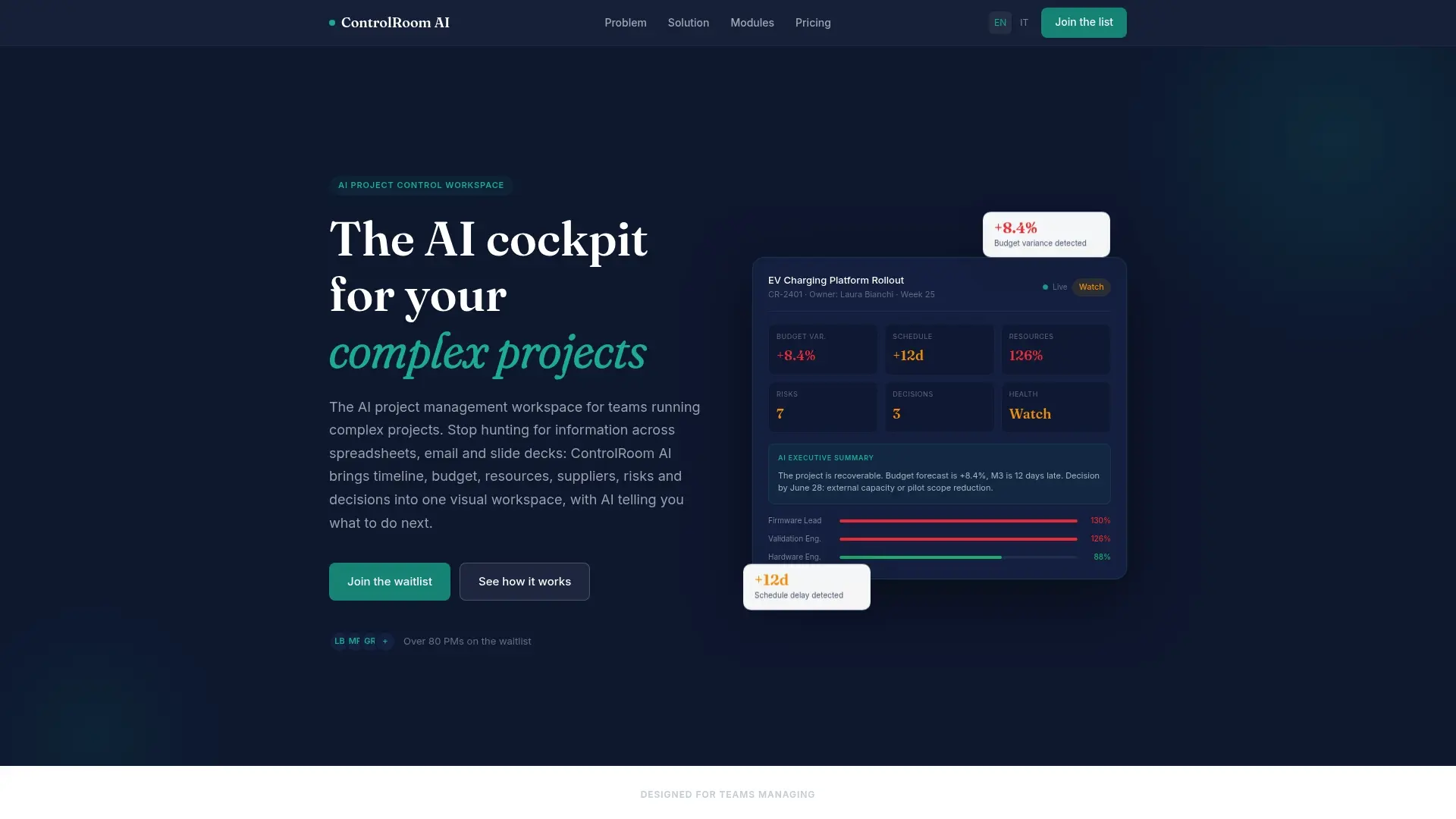
ControlRoom is Viniciolupo's AI workspace designed for teams working on complex projects, where Waterfall and Agile coexist in the same execution. Centralize project control, support decisions with real-time data, and reduce time spent reconciling scattered information. For those managing R&D or IT projects with mixed requirements, iControlRoom use casesthey show how real teams solved exactly this problem. Those who want to explore the features directly can find everything onControlRoom.
Frequently asked questions
What is the main difference between Waterfall and Agile?
Waterfall plans everything before launch and proceeds in sequential phases, while Agile works in short sprints with continuous feedback. The operational difference is that in Waterfall changes are expensive, in Agile they are expected.
When is it best to use a hybrid approach?
The hybrid approach is convenient when the project has an initial phase with stable requirements and an executive phase with high technical uncertainty. The Water-Scrum-Fall model uses Waterfall for planning and closure, Agile for iterative development.
Does Agile work without documentation?
No. Agile requires minimal but functional documentation, proportionate to the complexity of the project. Eliminating all documentation in the name of agility generates technical debt and knowledge transfer problems.
What are the main risks of Waterfall?
The main risk is the late discovery of errors: defects that emerge only in the final testing phase require reopening phases that have already been closed, with high impacts on costs and time. This risk grows proportionally to the duration of the project.
How to choose between Agile and Waterfall in 2026?
Evaluate three criteria: requirements stability, stakeholder availability, and time-to-market urgency. Stable requirements and regulatory constraints indicate Waterfall; variable requirements and mature teams indicate Agile; the combination of the two indicates a hybrid approach.