

The transition to the agile methodology is a cultural and operational change, not a simple process update. Managing the agile methodology transition successfully requires dedicated governance, redefined roles and an incremental approach that reduces risks without blocking operational continuity. Italian team leaders and project managers who face this challenge without a structured framework risk obtaining the opposite effect: more confusion, more resistance, fewer results. This article provides a concrete roadmap, with verified tools, real data and lessons learned from cases like Kraft Heinz.
What are the prerequisites to start the agile transition?
Before initiating any change, three conditions are needed: dedicated temporary governance, at least one carefully selected pilot project and a minimum set of shared visual tools. Without these elements, the transformation is reduced to a series of unsuccessful meetings.
Thetemporary governanceit is the most underestimated condition. The agile transition is not a single event but a state of government that requires roles and decision-making cycles distinct from ordinary ones. It means appointing a transition manager, defining a steering committee and establishing review schedules separate from current management.
The pilot project must be representative but not critical. A frequent mistake is choosing the most complex project to "demonstrate the value" of agile. Better to select a project with a team of 5–8 people, a horizon of 3–4 months and measurable output. The5-step Kaizen modelit is particularly suitable for Italian SMEs with up to 250 employees: it provides progressive extensions instead of a total implementation in a single phase.
The tools to be adopted in the initial phase must be simple and accessible:
- Kanban boardphysical or digital to visualize the workflow
- Quarterly OKRsto align team and business goals
- Daily standupof 15 minutes to synchronize priorities and blocks
- Biweekly retrospectivesto gather feedback and correct course
- Product Backlogshared to manage priorities transparently
A tip: involve middle management before communicating the change to the rest of the team. Middle-level managers are often the main bottleneck: if you turn them into facilitators instead of leaving them as controllers, they become the driver of the transition.
How does the agile transition take place step by step?
An effective agile transition follows a "pull" logic, not a "push" one. The team adopts practices because they see direct value, not because a manager imposes it from above. This fundamentally changes the way you design your roadmap.
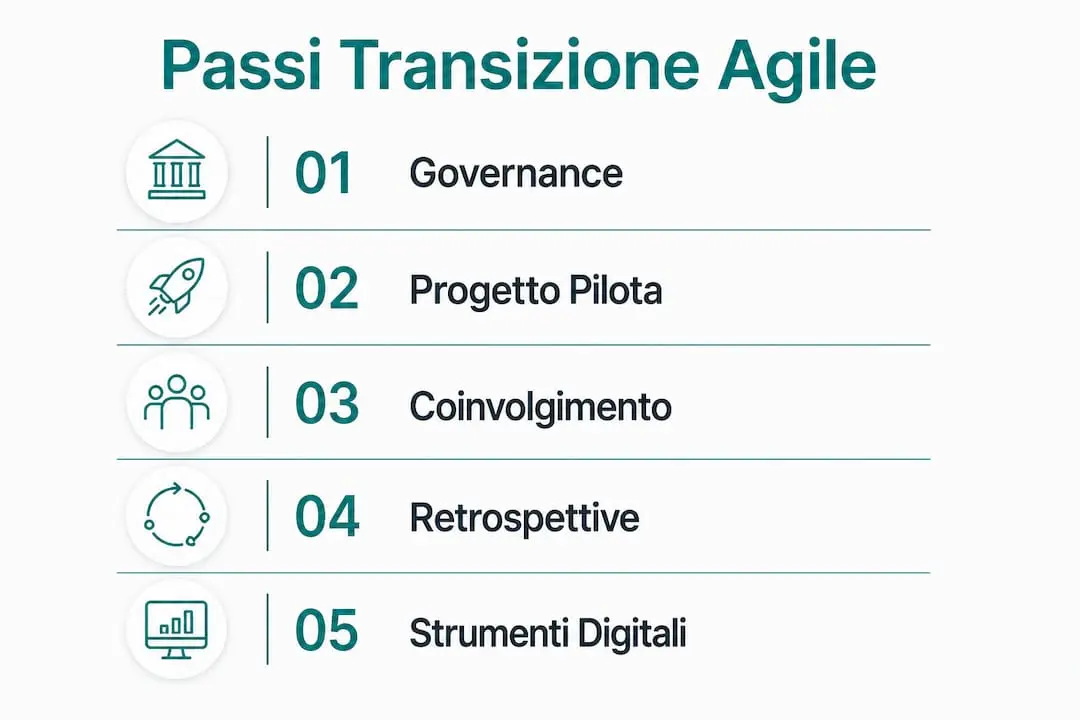
- Diagnosis of the current situation.Map existing workflows, identify bottlenecks and measure cycle times. Without a clear baseline, you can't evaluate progress.
- Targeted training for roles.There is no need to train everyone the same way. Team leaders need to understand Scrum and Kanban. Managers need to understand how their role changes to that of facilitators.
- Start of the pilot project.Apply your chosen framework to your 2-week sprint pilot. Document each retrospective and make the results visible to the entire organization.
- Review and adaptation of the plan.After the first cycle, revise the plan based on the data collected. Oneeffective agile strategyit is a living adaptive process, not a definitive document.
- Progressive extension.Bring the validated practices to the second team, then to the third. Don't mechanically copy the pilot model: adapt it to the specific constraints of each department.
- Definition of transition KPIs.Track metrics such as cycle time, number of blocks resolved per sprint, and OKR completion rate. These indicators indicate whether the transition is progressing or stalling.
The role of the leader changes substantially during this process. Leadership in organizational transitions requires skills different from ordinary ones: managing uncertainty, making reversible decisions and maintaining the coherence of the message across multiple hierarchical levels.
A tip: treat each pilot failure as a given, not as an error. Retrospectives serve precisely this: to transform the negative experience into structured learning. If the team is afraid to report problems, the transition is already compromised.

What cultural challenges do you encounter during the agile transition?
Resistance to agile change almost always arises from the fear of losing control and role, not from the methodology itself. This is the point that many implementation plans ignore, focusing on processes and neglecting people.
Middle managers experience the transition as a threat to their authority. Their traditional role, based on control and distribution of tasks, is called into question by a model that delegates autonomy to teams. The solution is not to ignore this tension, but to explicitly redefine their contribution as facilitators and removers of obstacles.
The most common cultural challenges to face are:
- Compliance to ownership mentality:the team must move from "I do what I'm told" to "I take responsibility for the result".
- Uncertainty tolerance:agile plans change. Those used to rigid annual roadmaps struggle to accept sprints that are redefined every two weeks.
- Work visibility:making work visible on a Kanban board may seem like a loss of autonomy for those who were used to managing their time without continuous reporting.
- Feedback as a tool, not as judgment:Retrospectives only work if the team perceives the feedback as an opportunity for improvement, not as an evaluation of individual performance.
The Kraft Heinz case is one of the most cited examples in the literature on agile transformation outside of IT. The adoption ofQuarterly OKRs and decision-making autonomyreduced time to market by 6 times. The result did not come from the trials, but from the cultural change that preceded them.
«The success of the agile transformation depends on overcoming the fear of losing control and on a change of mentality from compliance to ownership. Without this step, agile tools become just a new layer of bureaucracy."
Cohesive leadership on multiple levels is the condition that separates successful transformations from those that stall after the first pilot. If the CEO talks about agile and the function directors continue to request monthly reports in waterfall format, the message that reaches the teams is unequivocal: the change is not real.
Which digital tools support agile implementation today?
Digital tools accelerate the transition only if they integrate with practices already adopted. A sophisticated tool introduced before the team has consolidated retrospectives and the backlog becomes a hindrance, not a help.
The integration between Scrum framework and Lean Thinking is the most solid starting point.Scrum and Lean integrateshifting attention from the organization chart to the value stream. Lean eliminates waste in processes; Scrum structures work in short cycles with continuous feedback. Together, they offer an adaptive structure that works even in non-IT contexts.
Artificial intelligence adds a decision-making layer that traditional frameworks do not cover. Organizations thatintegrate AI into decision-making processesagile reduce approval times for innovation projects by up to 40% by 2026. This means fewer bottlenecks in prioritization decisions and more time for actual work.
| Tool | Main function | Suitable for |
|---|---|---|
| Digital Kanban board | Workflow visualization | Teams of any size |
| Shared Product Backlog | Task management and prioritization | Scrum and hybrid teams |
| Quarterly OKRs | Alignment of company and team objectives | Organizations in transition |
| User Story Mapping | Definition of value from the user point of view | Product owner and development team |
| Decision-making AI (e.g. ControlRoom AI) | Reduction of approval times and project visibility | PMO and project managers |
User Story Mapping techniques deserve specific attention. They allow you to visualize the end user's journey and link each task in the backlog to a concrete value. This makes priorities clearer and reduces the risk of working on features that no one will use.
For those managing complex projects with multiple teams, tools likeControlRoom AIthey offer real-time visibility into project status, flag risks before they become problems, and support quick decisions without requiring additional meetings. Theprocess optimization with AIit is now also accessible to SMEs, not just large organizations.
Teams that adopt integrated backlog tools and a collaborative culture see a 31% reduction in meetings and a 55% increase in team member satisfaction. Fewer meetings and more actual work: this is the concrete result of a well-managed agile transition.
Key points
Managing the agile methodology transition requires dedicated governance, active culture change, and incremental tools that grow with the team.
| Point | Details |
|---|---|
| Temporary governance | Appoint a transition manager and a steering committee separate from day-to-day management. |
| Incremental approach | Use the 5-Step Kaizen Model: Extend agile practices progressively, not in one go. |
| Involvement of middle management | Transform middle managers from controllers to facilitators before starting the pilot. |
| Culture before tools | The change from compliance to ownership precedes the adoption of any framework or software. |
| Transition KPIs | Monitor cycle time, resolved blocks, and OKR rate to gauge real transformation progress. |
Agile change that works is slow, not sudden
I've seen many organizations start the agile transition enthusiastically and stall after three months. The pattern is always the same: the tools are adopted, the courses are held, the Scrum Masters are appointed. Then comes the first critical project and everything goes back to how it was before. Waterfall, alignment meetings, centralized decisions.
The problem is never the methodology. It's that you treat the transition as a project with an end date, instead of managing it as a permanent change of state. Temporary governance does just that: to create a protected space in which new practices can take root before being exposed to ordinary operational pressure.
The mistake I see most often in Italian technical teams is mechanically transferring the driver's model to the other departments. Each team has different constraints, a different history and a different tolerance threshold for change. Adapting the framework is an act of respect towards people, not a methodological weakness.
The thing that convinced me the most, working with teams in transition, is that agile works when it stops being "the new method" and simply becomes "the way we work". That moment only comes if leadership is consistent, visible and willing to change first. Teams cannot be asked to embrace uncertainty if executives continue to demand certainties that the market cannot provide.
— Vinicio
Viniciolupo and ControlRoom AI for your agile transition
Managing complex projects during an agile transition requires real-time visibility, not just good methodological intentions.
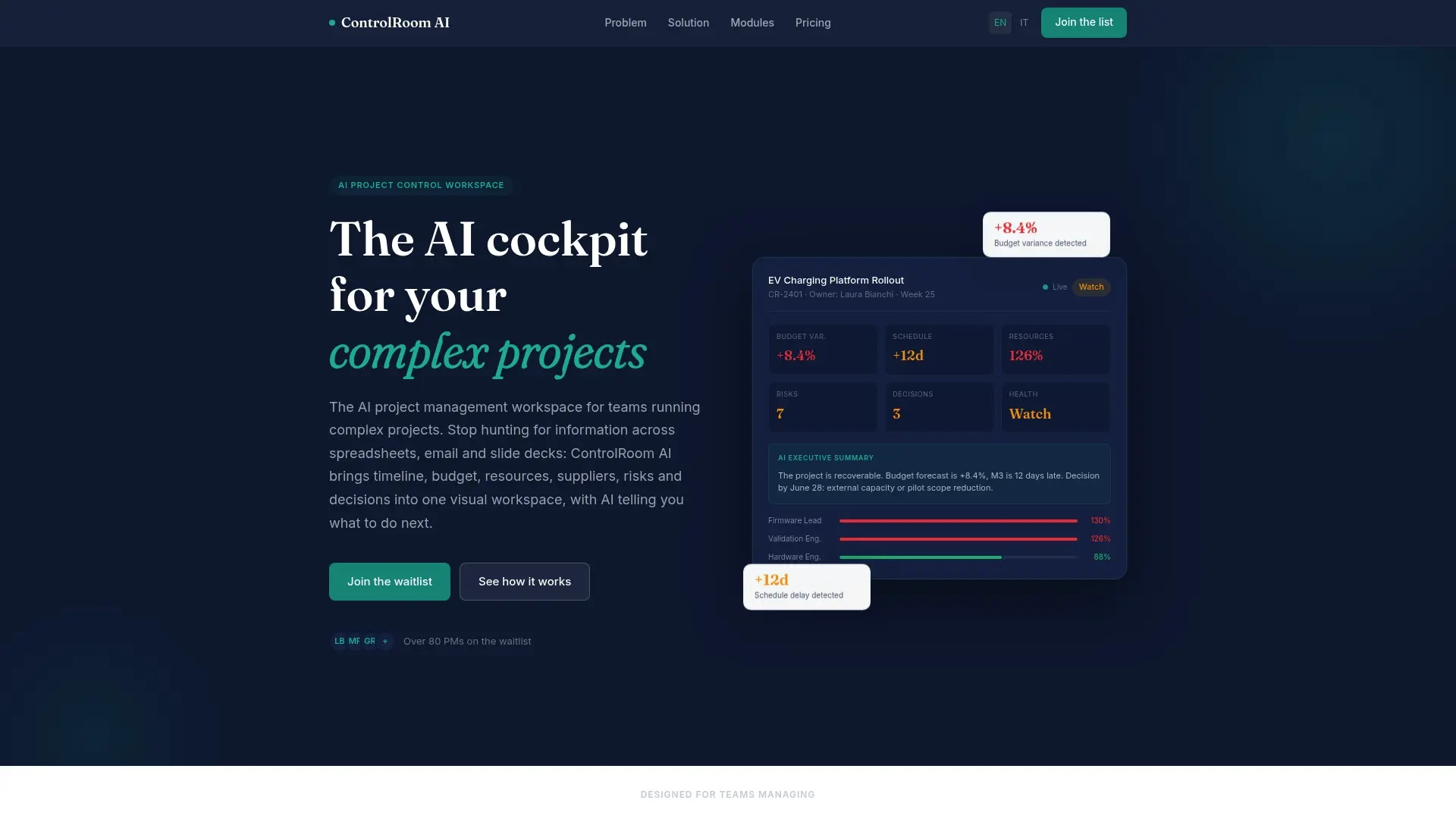
Viniciolupo has developedControlRoom AI, a workspace for agile management of complex projects that integrates AI decision support and workflow visualization. It allows you to monitor progress, identify risks before they materialize and reduce the time spent on alignment meetings. For those who want to assess their readiness before starting the transition, theProcess Readiness Tooloffers AI-driven analysis in minutes. Free resources and dedicated advisory are available to support every phase of implementation.
Frequently asked questions
How long does a complete agile transition take?
A complete agile transition typically takes 12–24 months to establish in a stable manner. The first pilot is completed in 3–4 months, but organization-wide extension and cultural change require longer cycles.
Where do you start if the team has never used agile methodologies?
It starts with a small pilot project, a shared Kanban board and bi-weekly retrospectives. Agile training on key roles, such as team leader and product owner, precedes the adoption of the tools.
How do you manage resistance from middle management?
Resistance is reduced by involving middle managers in defining the new role before the transition begins. Those who participate in planning change rarely sabotage it.
Are OKRs necessary for agile transition?
OKRs are not mandatory, but they accelerate the alignment between business objectives and sprint priorities. The Kraft Heinz case shows that the adoption of quarterly OKRs directly contributed to the reduction of time to market.
Does agile only work in IT?
Agile works in any business function as long as the transition is guided correctly. Marketing, operations and R&D have adopted agile frameworks with measurable results, adapting practices to their operational constraints.