

Project management automation is the use of digital systems to perform repetitive tasks, streamline workflows, and improve internal communication without manual intervention. For Italian managers, automating project management is no longer a competitive advantage: it is the basic condition for keeping pace. Theautomation of project communicationsreduces response times by between 50% and 60%, with a direct decrease in the number of meetings. This means less time spent chasing updates and more time spent making decisions that matter.
Because automating project management reduces errors and increases quality
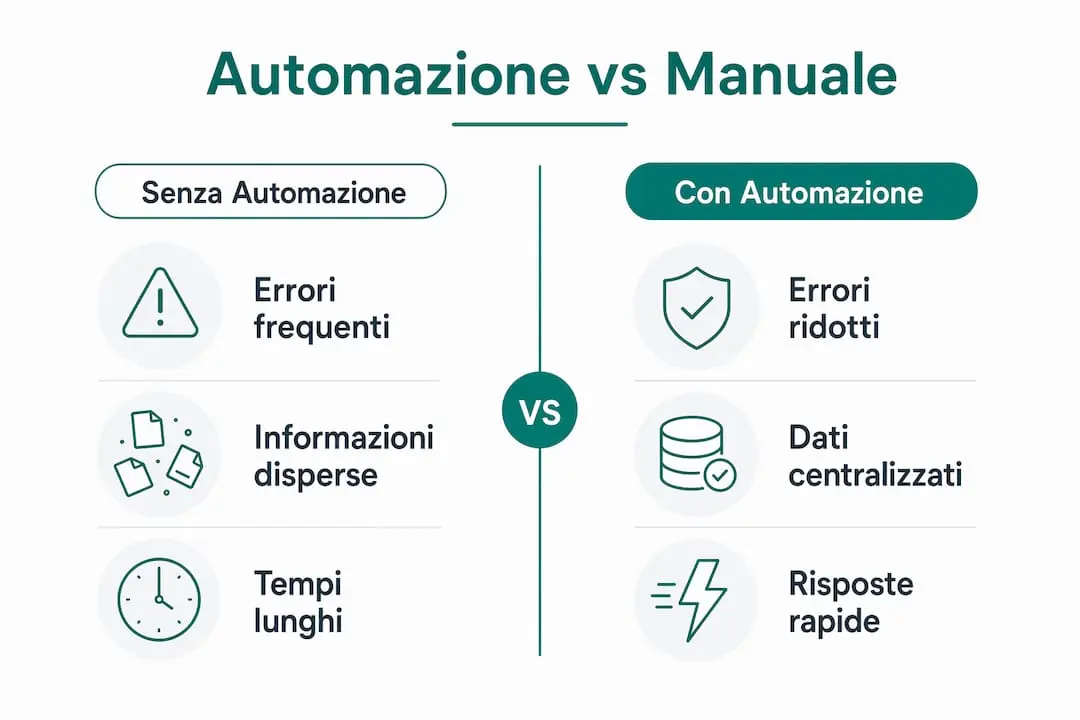
Errors in project management almost always arise from manual processes: a forgotten email, a status update not communicated, a document in the wrong version. Automation eliminates these breaking points by replacing human intervention with predefined, verifiable flows.
Thestandardization of processes through automationimproves work consistency and reduces gaps or errors in distributed or fast-paced teams. This is particularly true for Italian SMEs, where the same person often manages multiple roles and organizational memory is fragile.
The most common tasks to automate to reduce errors are:
- Expiration notificationsautomatically sent to task managers, without the project manager having to remember it manually
- Progress reportgenerated on a fixed basis and distributed via email to the team and stakeholders
- Blocking alertswhen an activity remains stopped beyond a configured time threshold
- Completeness checkson the documents before they move on to the next stage
Automation software frees up time for critical tasks by improving clarity, tracking, and responsiveness to change. The result isn't just fewer errors: it's a team that works with more clarity on what to do and when.
A tip: Set up automatic notifications for specific times of the workday. The overload of notifications generates "notification fatigue" and leads collaborators to ignore alerts. Set do-not-disturb hours and review active alerts weekly to eliminate unnecessary ones.
Because centralizing project documentation changes everything
The lack of centralization of data generates silos that prevent a complete vision of the project and hinder effective decisions. When files reside in different shared folders, emails contain misaligned versions of documents, and progress data lives in separate spreadsheets, the project manager wastes hours every week just reconstructing the real picture.
Thecentralized project managementconnects estimates, times, purchases and deliverables in a unified vision, essential for measuring performance reliably. An integrated system transforms scattered data into a readable dashboard, where every team member sees exactly the status of every task.
The concrete advantages of a centralized archive include:
- Reduction of document search time, which in SMEs can absorb hours of productive work every week
- Automatic versioning that eliminates the risk of working on obsolete files
- Controlled access by role, so each employee sees only what they need
- Complete traceability of changes, useful during the review or audit phase
Adopt structured systems such as a PDM or an ERP with project modulereduces time spent on researchof technical information and introduces repeatable working methods. It's not just about storage: it's about building organizational memory that is accessible and updated in real time.
| Problem without centralization | Benefit with centralized system |
|---|---|
| Documents in different versions across multiple channels | Single source of truth with automatic versioning |
| Status updates communicated via email | Shared dashboard updated in real time |
| Manually search for files and data | Instant access with integrated search |
| No traceability of changes | Complete log of every variation |

For those who managecomplex technical processes, centralization is not an option: it is the precondition for any effective automation.
Which processes should you automate to get quick results?
Automating everything at once is the surest way to create chaos. The right choice is to start with the most critically inefficient processes, those that consume the most time or generate the most errors, and build from there.
Automating the most critical processes in SMEs generates visible returns in just a few weeks and creates the momentum needed to extend automation to other areas. This gradual approach protects the team from overload and allows it to learn from the first flows before replicating them.
The high-impact processes to automate first are:
- Automatic progress update: each completed task updates the dashboard without anyone having to enter data manually
- Project notifications: Automatic alerts for deadlines, blocks and pending approvals, sent to the right manager at the right time
- Report generation: weekly or monthly reports produced and distributed automatically, without manual data collection work
- Onboarding new tasks: When you open a new project, the system automatically creates the folder structure, assigns roles, and sends initial instructions
- Automatic escalation: if a task exceeds the deadline without updates, the system notifies the higher hierarchical level
A tip: Before setting up any automation, map out your current flow on paper. Mapping triggers and workflows takes an initial 20–30 hours, but avoids automating already broken processes, multiplying problems instead of solving them.
For those who want to understand where to start, theProcess Readiness Toolof Viniciolupo evaluates the company's preparation for automation and indicates the priority processes to be addressed.
How artificial intelligence transforms the role of the project manager
AI does not replace the project manager: it transforms him into an orchestrator who uses data to make faster and more well-founded decisions. This is the most relevant change for Italian managers in 2026.
Artificial intelligence in project management enriches the role of the manager, transforming him into an "intelligent orchestrator" who interprets system signals to guide the team towards strategic, not just operational, objectives.
TheAI automates transcription, reporting and contextual reminders, freeing the project manager from data collection and formatting activities. The technologies involved include machine learning for predictive planning, NLP for communications analysis and intelligent automation for managing dependencies between tasks.
The concrete benefits for a manager who adopts AI tools are:
- Predictive planning: The system flags delay risks in advance based on the team's historical data
- Communications analysis: NLP identifies blockages or tensions in project conversations before they become problems
- Automatic plan updates: when a variable changes, the system recalculates the dependencies and updates the plan without manual intervention
- Data-driven decisions: the manager sees patterns that would be invisible to the naked eye, such as tasks that systematically slip for the same reason
The emerging skills for managers in 2026 are not technical in the traditional sense. You need the ability to interpret AI output, configure intelligent flows and communicate decisions to the team with the clarity that data makes possible. Those who develop these skills now will have a structural advantage in the coming years. To delve deeper into this topic,articles on AI and automationby Viniciolupo offer updated analyzes on the role of the manager in the AI era.
Key points
Automating project management reduces errors, centralizes information and frees the manager for strategic decisions, provided that we start from an accurate mapping of the processes.
| Point | Details |
|---|---|
| Reduction of response times | Communications automation cuts response times by 50%–60%, reducing meetings. |
| Data centralization | A single archive eliminates silos and guarantees an updated and reliable vision of the project. |
| Automation priorities | Starting from the most critical processes generates visible returns in a few weeks and creates momentum. |
| Role of AI | AI transforms the manager into an orchestrator who uses data for strategic, not operational decisions. |
| Preliminary mapping | Dedicating 20–30 hours to flow mapping avoids automating already flawed processes. |
My experience with automation: what really works
I've been working with project teams for years and I've seen one mistake repeat itself with almost comical frequency: companies buy an automation tool and set it up in an afternoon. The result is invariably the same: notifications that no one reads, flows that jam at the first exception, and a team that goes back to using emails because "at least I understand those".
The inconvenient truth is that automation doesn't simplify a chaotic process. It speeds it up. If your document approval flow is already confusing, automating it just means you get confirmation faster that the process isn't working. The analysis and mapping phase is not a luxury: it is the real work.
The other error I often see concerns notifications. Managers set up alerts for everything, convinced that more information means more control. In reality, a team that receives thirty notifications a day stops reading them all. Discipline in automatic notifications, few, targeted and sent at the right time, is worth more than any elaborate dashboard.
The advice I always give is to start with just one process, the most painful, and automate it well. Then measure. Then extend. Anyone who follows this logic gets results in weeks. Those who want to automate everything immediately return to the starting point in months.
— Vinicio
Viniciolupo and the automated management of complex projects
Managing complex projects with generic tools means adapting the work to the tool instead of the other way around. Viniciolupo built ControlRoom AI as a specific workspace for managers and team leaders who coordinate technical and R&D projects.
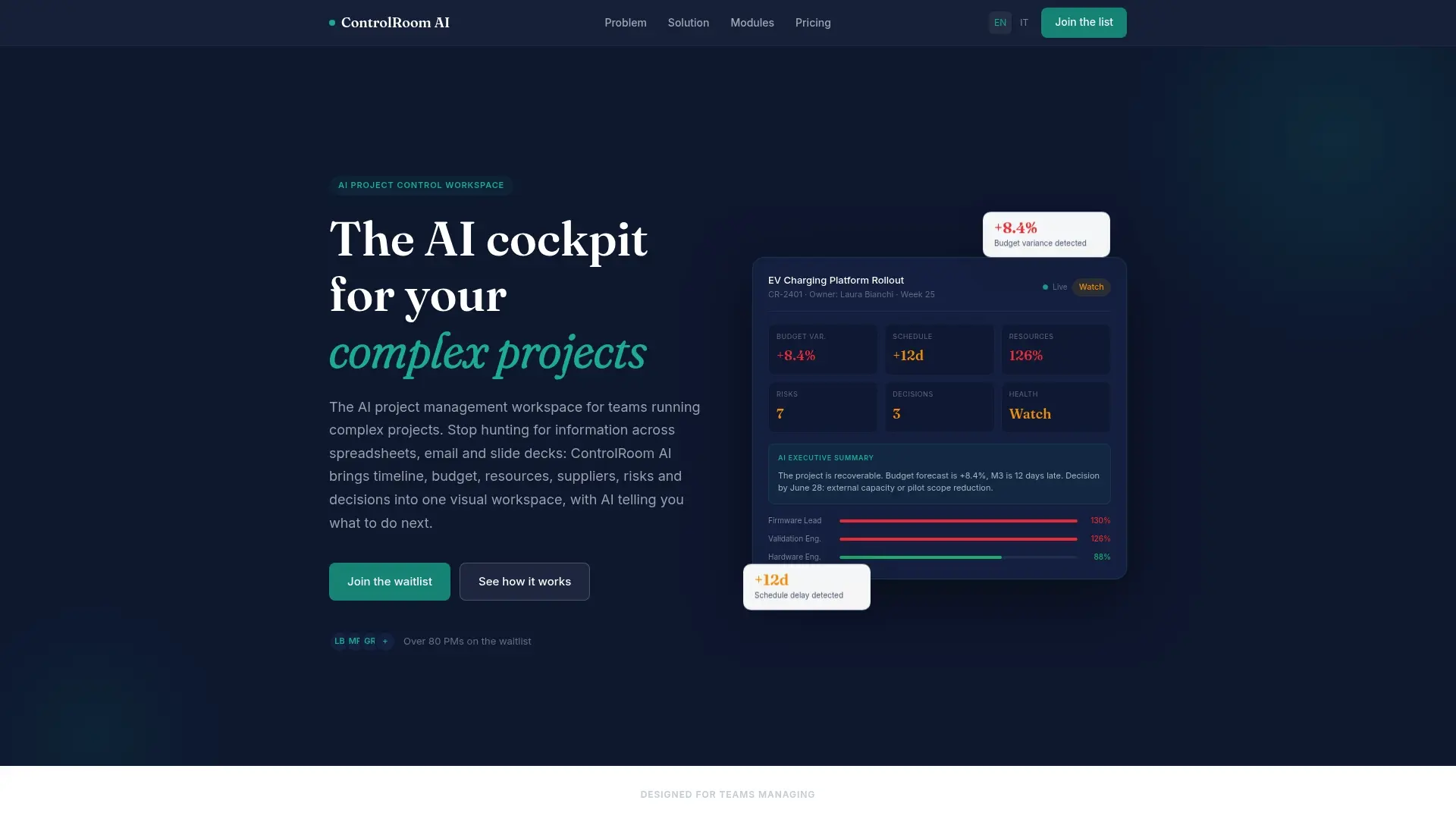
ControlRoom AI integrates flow automation, automatic progress updating and documentation centralization in a single environment. The system is designed for those who need to keep complex dependencies, multiple deadlines and distributed teams under control. For those who want to evaluate their preparation before investing in automation, theProcess Readiness Tooloffers a free diagnosis in just a few minutes. For those ready to take the next step,ControlRoom AIit is the starting point.
Frequently asked questions
What is automation in project management?
Automation in project management is the use of digital systems to perform repetitive tasks, such as notifications, reports and status updates, without manual intervention. The goal is to free the manager for strategic decisions.
Why centralize project documentation?
The lack of centralization generates information silos that prevent a complete vision of the project and slow down decisions. A centralized repository ensures a single source of truth, with automatic versioning and controlled access by role.
How do I set up project notification automations?
Automatic notifications are configured by defining specific triggers, such as a deadline passed or a task completed, and assigning the correct recipient. To avoid overload, it is recommended to limit alerts to truly relevant events and set non-disturbance times.
Which processes should you automate first in an SME?
The high-impact processes to automate first are updating progress status, generating periodic reports and expiration notifications. Starting from the most critical process generates visible returns in a few weeks.
Does artificial intelligence replace the project manager?
AI does not replace the project manager: it transforms him into an orchestrator who uses data for faster and more well-founded decisions. Technologies such as machine learning and NLP automate data collection, leaving strategic judgment to the manager.