

Knowledge management in R&D teams today is divided into five main categories, each with a distinct role in making technical knowledge accessible and alive. Here is a quick map to orient yourself:
- Wiki platforms and corporate knowledge bases: Confluence, Notion, SharePoint collect documentation, procedures and specifications in a single point that can be consulted by everyone.
- Real-time collaboration systems: Miro and shared work environments allow distributed teams to think together about complex problems without losing the context of decisions.
- Document management software: SharePoint and similar solutions store versions, provide traceability and control access to technical files.
- Project management platforms: Jira and similar tools translate knowledge into assignable tasks, deadlines, and approval flows.
- Cognitive layers with generative artificial intelligence: Amaltia, Rovo (integrated in Confluence) and Copilot (in SharePoint) synthesize information from certified sources, answer contextual questions and connect otherwise dispersed data.
The distinction that really matters is not between "old" and "new" tools, but between systems that make knowledge queryable and systems that only archive it.
Why knowledge management is a competitive factor in R&D

Fragmented knowledge is the main brake on innovation in research teams. When technical specifications live in emails, test results in local folders and design decisions in individual memories, each new development cycle starts almost from scratch. SecondAssoInnovatori, knowledge management in R&D breaks down information silos, improving productivity and interfunctional communication in a measurable way.
A key concept in this context is thedigital thread: a system that connects technical specifications, CAD/3D data, formulations and regulations into a single source of truth. Thedigital threadreduces handover errors between departments and accelerates time to market in industrial projects, because every change to a component automatically propagates to related specifications.
The concrete benefits of a systematic approach to knowledge management include:
- Reduction of duplication of work thanks to the centralization of knowledge and immediate search for documents already produced.
- Faster cross-functional collaboration, with formulation, quality and regulatory teams working on the same up-to-date data.
- Accelerated onboarding for new researchers, who immediately access manuals, procedures and decision history.
- Greater transparency into project status, with fewer alignment meetings required.
The most frequent challenges remain the resistance to change on the part of researchers accustomed to managing their knowledge autonomously, the information overload when repositories grow without a clear taxonomy, and the difficulty of integrating new tools with ERP or CRM systems already in use.
How artificial intelligence changes knowledge sharing in R&D
Generative AI is not a faster search engine. It's acognitive layerwhich summarizes information, connects data from certified sources and answers contextual questions that a traditional archive would not even be able to interpret.
Amaltiait is the most structured example available today for Italian enterprise environments. In the center of the platform there is asemantic knowledge graphowner that maps the relationships between documents, people, processes and systems. This prevents the repository from becoming a data cemetery: all information is contextualized, not just archived. Amaltia also guaranteesAI enterprise governancewith granular access policies, automatic versioning and complete audit trail, essential elements for those who operate in regulated environments or must comply with the European AI Act.
Bramble, integrated into Confluence, brings semantic search capabilities into existing company wikis, making a document base searchable that would otherwise require hours of manual navigation.
Copilotin SharePoint it acts in a similar way on the Microsoft ecosystem, generating summaries of documents, answering questions about files and connecting information dispersed in different folders.
Miroapproaches the problem from a different angle: it does not manage documents, but preserves the human context of decisions. Thetwo-way synchronizationwith Jira and Azure DevOps it allows you to transform brainstorming sessions into operational tasks without losing the reasoning that generated them.
Granular traceability and audit trail are not ancillary features: in R&D projects subject to regulatory review, knowing who changed what and when is a requirement, not an option.
How to implement these tools without wasting time and resources
Adoption almost always fails for the same reason: the tool is chosen before understanding where the knowledge is really lost. Before any purchase, map your team's information flows and identify the three points where information is most frequently dispersed or duplicated.
Some practical indications that make the difference:
- Build an active internal community.SecondELO Digital, creating spaces where researchers can ask questions, propose ideas and receive recognition transforms static knowledge into dynamic dialogue. An archive that no one feeds is as useless as no archive at all.
- Don't delegate everything to AI.Miro points out that the human context of discussions and decisions is exactly what AI tools lack. Using Miro to align the team before moving into technical development ensures that the code or specifications reflect the true intent of the group.
- Integrates ideation and project management tools.The bidirectional connection between Jira and Miro, for example, allows you to translate an insight that emerged during a work session directly into an assignable task, without intermediate manual steps.
- Measure usage, not just satisfaction.Indicators such as the number of searches carried out in the knowledge base, the rate of documents updated within 30 days of publication and the average time to find a technical specification say much more than an approval survey.
- Protect sensitive data from the start.Thecorporate data securityin R&D environments requires differentiated access policies by role, encryption and audit trails active before the system goes into production, not after the first incident.
A tip: adopts an integrated AI governance layer right from the initial configuration. Tools like Amaltia allow you to define who can access what information and track every change automatically, reducing the risk of inadvertent exposure of intellectual property.
Vinicio Lupo, in the analysis of complex R&D processes, highlights that the real challenge is not having more data, but having visible data at the right time. Transparency on project progress, visibility on decisions made and traceability of changes are the elements that distinguish an R&D team that scales from one that gets stuck on information bottlenecks. To delve deeper into these themes, thearticles on AI and R&D processesdi Viniciolupo offrono analisi concrete su come strutturare flussi di lavoro basati su dati.
Viniciolupo ControlRoom AI: visibility and control for R&D teams
Those who manage research and development projects know the problem well: the information is there, but it is scattered. Decisions are made, but they are not tracked. Teams align in meetings, then diverge in execution.
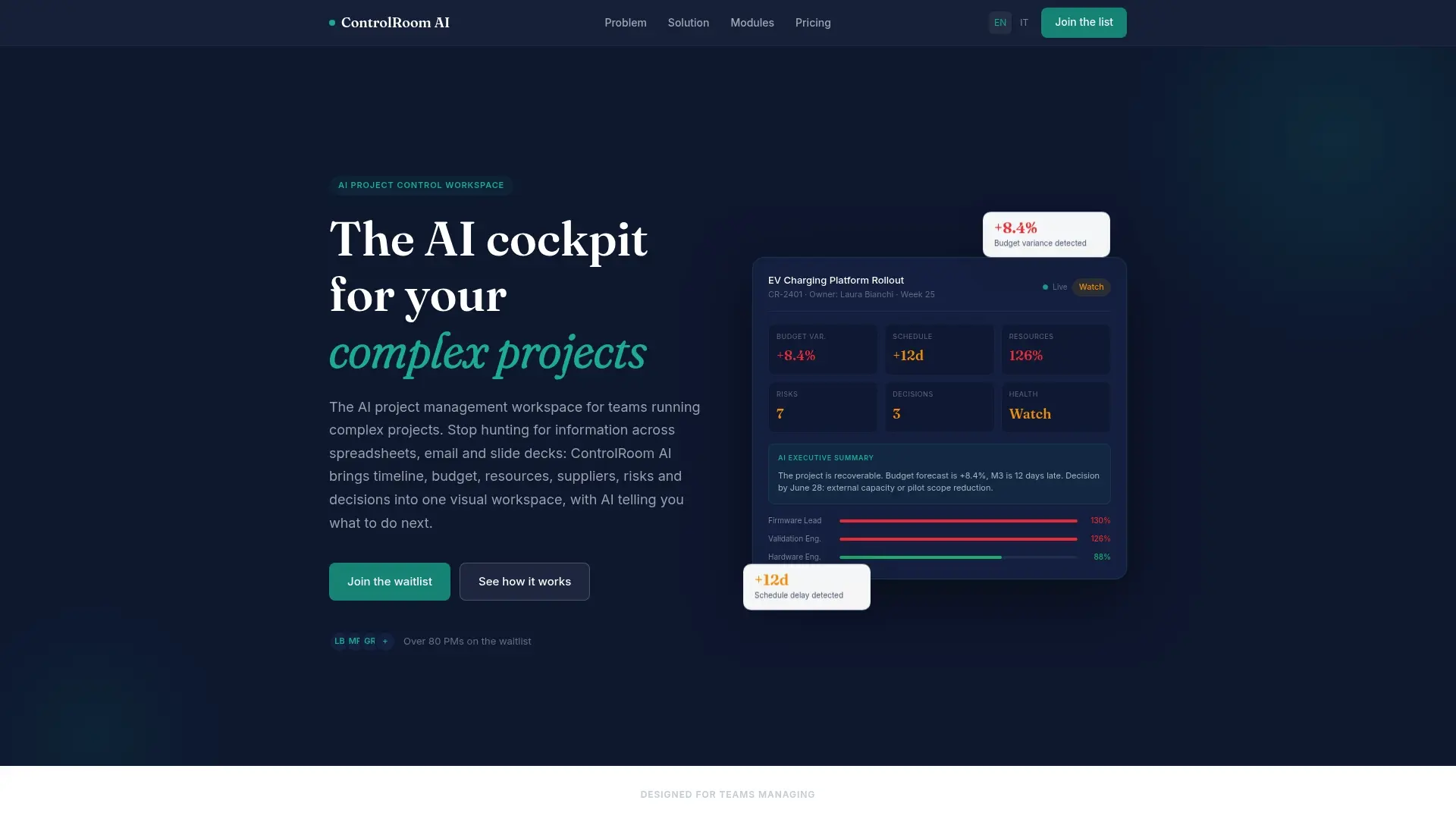
Viniciolupo's ControlRoom AI is built for this specific context. It is not a wiki, nor a ticketing system: it is an AI workspace for project management that connects technical knowledge to decision-making processes, giving team leaders a clear view on the status, dependencies and criticalities of each R&D project. Built-in AI supports data-driven decisions, flags blockages before they become delays, and keeps the context of technical choices accessible to the entire team. For those who want to coordinate research, development and documentation in a single environment,ControlRoom AIit is the starting point.
Key points
R&D knowledge sharing tools produce concrete results only when they combine AI technology, data governance and an active culture of contribution from researchers.
| Point | Details |
|---|---|
| Five categories of instruments | Wiki, real-time collaboration, document management, project management and AI layer cover distinct and complementary needs. |
| Digital thread as a single source | Connecting CAD data, standards and specifications into a single system reduces errors and accelerates time to market. |
| Contextual generative AI | Tools like Amaltia and Rovo make the knowledge base searchable, not just consultable, thanks to semantic knowledge graphs. |
| Governance and audit trail | Granular access policies and automatic tracking are compliance requirements, not optional features in regulated R&D environments. |
| Viniciolupo ControlRoom AI | Connects technical knowledge and project management in a single AI space, improving visibility and alignment across R&D teams. |