

Evaluating the progress of an innovation project means measuring technical progress, financial sustainability and project quality in a structured way, to make informed decisions at each stage. Unlike traditional projects, innovation projects have high technical uncertainty and objectives that change over time. For this, project managers need methods that combine recognized technical criteria, such as those of the Frascati Manual, with digital tools capable of monitoring progress in real time. Without this combination, the assessment remains superficial and risks remain hidden until they become costly.
How to evaluate the progress of an innovation project with the Frascati criteria
TheFrascati Manualdefines five criteria that a project must meet to qualify as research and development: novelty, creativity, uncertainty, systematicity and transferability. All five must be present at the same time. This is not just a fiscal requirement: it is also the most rigorous way to verify whether a project is truly progressing on a path of real innovation.
Applying these criteria to monitoring means documenting each phase with concrete evidence. Documentation must include prospective evidence of technical uncertainty and tested hypotheses, not retroactive reconstructions. A laboratory diary updated weekly is worth much more than a final report drawn up at the end of the project.
Here's how to translate each criterion into a concrete monitoring action:
- New:documents what distinguishes the project from the state of the art. Update this section whenever a relevant technical finding emerges.
- Creativity:records the original solutions adopted to overcome technical obstacles. These steps demonstrate that the team faced unresolved issues.
- Uncertainty:keep a log of open hypotheses and failed tests. A project without documented uncertainty is not R&D.
- Systematicity:shows that the work follows a methodological plan, with defined phases, resources and responsibilities.
- Transferability:indicates how the results can be applied or communicated to other contexts.
A tip: draw up short periodic reports (even just one page) that highlight deviations from the initial hypotheses. These documents are the strongest evidence of technical uncertainty and protect the project in the event of a tax audit.
The most common mistake is to qualify a project as R&D without documenting the uncertainty prospectively. This weakens both the technical credibility and fiscal defensibility of the tax credit.
What digital tools should you use to monitor progress?
Thedigital tools for reportingthey transform monitoring from a static control to a decision-making asset. Interactive dashboards like Power BI or Google Data Studio allow you to visualize progress in real time, connecting technical, financial and impact data in a single view. This reduces the time teams spend collecting data manually and increases the quality of decisions.

The integration of artificial intelligence adds a further level: AI analyzes patterns in project data, reports anomalies and generates predictions on future trends. The result is that project managers receive warning signals before problems become critical, not after.
The most useful tools for monitoring an innovation project are divided into three categories:
- Progress display:Gantt charts updated in real time, burndown charts, dependency maps between activities.
- Data Analysis:AI dashboards that aggregate technical and financial KPIs, with automatic alerts on deviations.
- Structured reporting:periodic report templates that document hypotheses, tests and results, useful both for internal governance and for R&D qualification.
A tip: connect your project management tools to a centralized dashboard. Even a simple setup with Google Data Studio reduces report preparation time by 60–70% compared to manual spreadsheets.
Thedata breach risk managementit is an aspect often overlooked when adopting digital tools for monitoring. Before integrating new platforms, check that they comply with GDPR requirements and that project data is protected.
Viniciolupo offersControlRoom AI, a platform designed for advanced monitoring of complex innovation and R&D projects, with AI analytics capabilities integrated directly into the team's workflow.
How does preventive evaluation work to optimize resources?
A structured preventive evaluation allows you to identify critical areas and chances of success before investing weeks in tender applications. This approach reduces the risk of wasting resources on projects that would not pass selection. The preventive analysis replicates the logic of the evaluation commissions, weighing three distinct dimensions.
The model is divided into three sequential phases:
- Formal eligibility (30%):verifies that the project complies with all regulatory and documentary requirements required by the tender or incentive. Errors at this stage automatically disqualify the application.
- Financial sustainability (35%):analyzes the solidity of the economic plan, the consistency between expected costs and objectives, and the company's ability to co-finance the project.
- Design quality (35%):evaluates the clarity of the technical objectives, the feasibility of the work plan and the relevance of the innovation compared to the state of the art.
AI accelerates this analysis significantly. While traditional preparation of an application takes weeks,AI reduces preparing timesof the technical report, providing structured preliminary versions to be integrated with professional supervision. The process is divided into four phases: AI pre-qualification, mapping and classification, preparing, final review with expert judgement.
A tip: uses preventive evaluation not only for tenders, but also for internal project reviews. Applying the same criteria every quarter gives you an objective measure of qualitative progress, not just temporal progress.
For projects exceeding 10 million euros, thelegislation on innovation agreementsit also requires a Plan that respects the DNSH principle, with documentary evidence of the environmental impact of the life cycle of products and processes. This adds a sustainability dimension to the qualitative assessment.
Which KPIs should you choose to measure innovation progress?
A limited number of targeted key indicators are more effective for monitoring than an overly broad set of KPIs. Specific, measurable indicators facilitate real-time course correction, while a dashboard overloaded with metrics paralyzes decisions instead of supporting them.
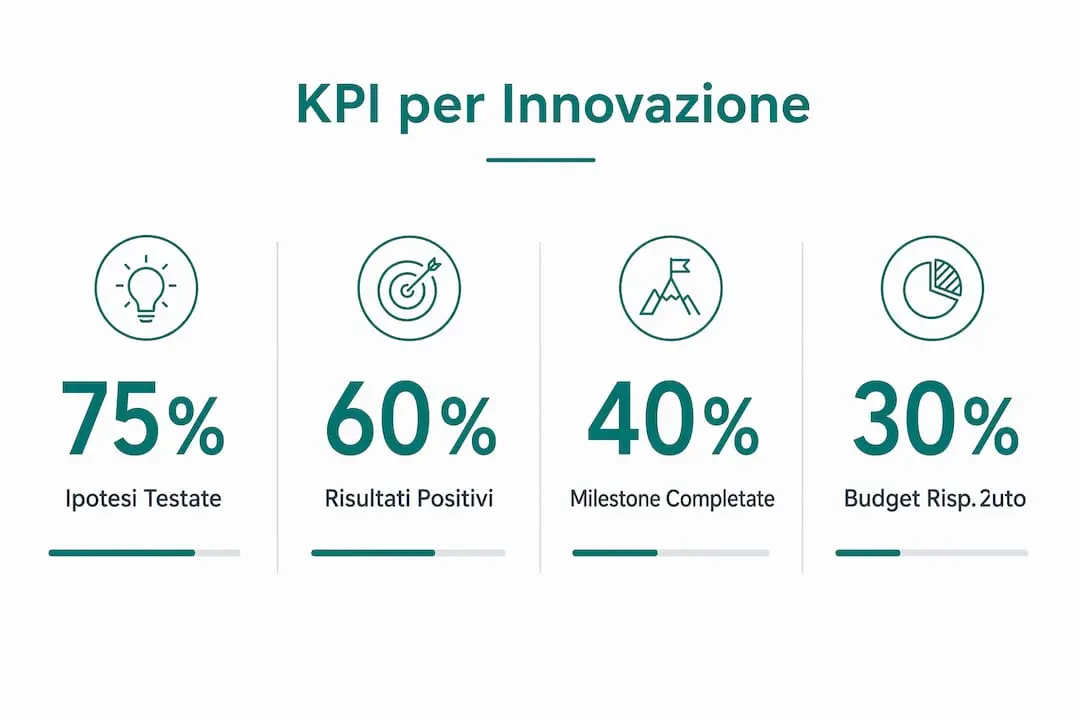
The KPIs for an innovation project are divided into three functional categories:
| Category | Examples of KPIs | Measurement frequency |
|---|---|---|
| Technicians | Number of hypotheses tested, rate of resolution of technical blocks | Weekly |
| Financial | Budget variance, cost per milestone achieved | Monthly |
| Impactful | Degree of novelty compared to the state of the art, potential for transferability | By phase |
Project milestones are the key moments to evaluate progress, correct course and ensure visibility to stakeholders. Each milestone must have completion criteria defined in advance, not after the fact.
For projects with high technical uncertainty, qualitative scoring methods such as theBerkus methodthey translate intangible factors into objective scores. This approach is particularly useful in the early-stage phases, when historical data does not exist and traditional financial evaluation does not work.
Adapt KPIs to the uncertainty of the project: in the initial phases, favor learning indicators (validated hypotheses, completed experiments). In advanced stages, shift the weight towards outcome indicators (working prototype, actual vs. expected costs).
Key points
Assessing the progress of an innovation project requires recognized technical criteria, targeted KPIs and digital tools that transform data into timely decisions.
| Point | Details |
|---|---|
| Frascati criteria as basis | Document all five criteria prospectively, not retroactively, for each phase of the project. |
| Structured preventive assessment | Analyze eligibility, financial sustainability and project quality before investing resources. |
| Limited and targeted KPIs | Choose a few technical, financial and impact indicators, adapting them to the uncertainty of each phase. |
| Dashboard and AI for monitoring | Use digital tools to centralize data and receive real-time warning signals. |
| Milestones as verification points | Define completion criteria for each milestone before starting the next phase. |
Because most teams misjudge progress
I've worked with dozens of innovation teams who produced detailed reports every month, but couldn't say for sure whether the project was actually progressing. The problem wasn't a lack of data. It was the lack of a framework that distinguished movement from actual advancement.
The Frascati Manual is not just a fiscal tool. It's one of the few methodologies that forces a team to answer uncomfortable questions: "What don't we know yet?" and “How are we documenting what doesn't work?” A project that does not record failures and deviations is not innovating. He's performing.
The most costly mistake I see is using output KPIs (deliverables delivered, hours worked) as a proxy for technical progress. These indicators measure activity, not progress towards the innovation goal. A team can deliver everything on time and end up with an irrelevant technical result.
AI changes this dynamic in a concrete way. Not because it replaces expert judgment, but becausea hybrid approach between AI and human expertiseguarantees the best quality in evaluation procedures. AI processes data faster; the expert interprets the context and validates the conclusions. Separating these two roles is the only way to obtain reliable assessments on high-uncertainty projects.
For those managing R&D projects, I recommend integrating preventive evaluation as a quarterly practice, not just as a pre-tender exercise. Applying the same criteria used by the evaluation commissions to your project, on a regular basis, is the most direct way to understand where you really are and where you want to go. Theinsights into AI and project managementby Viniciolupo offer concrete cases on how to structure this process.
— Vinicio
Viniciolupo for monitoring your innovation projects
Viniciolupo has developed specific tools for teams managing complex innovation and R&D projects.
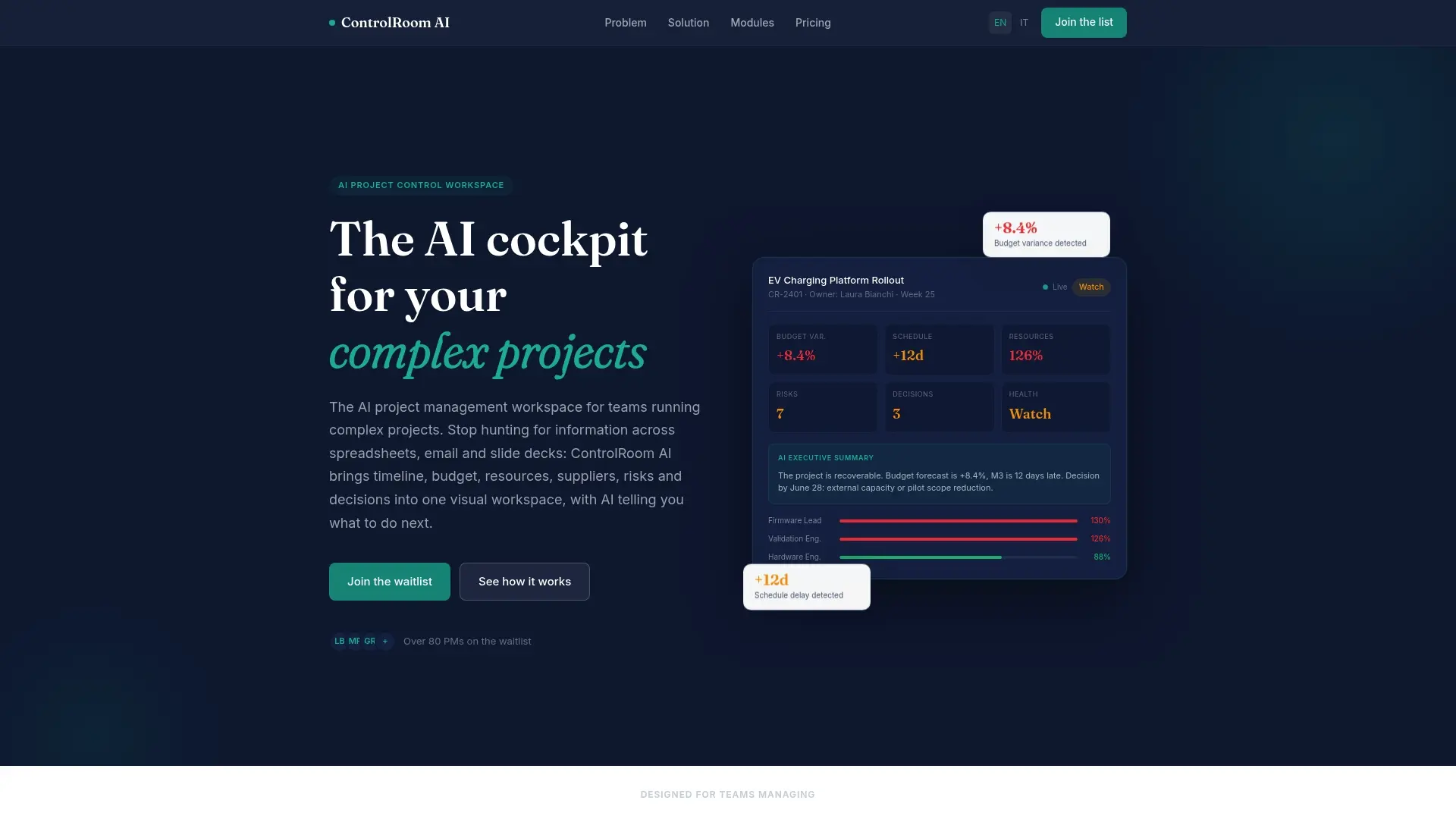
ControlRoom AIis the project management platform with integrated AI, designed to monitor technical and financial progress in real time, generate structured reports and report deviations before they become critical. For those who want to start without obligation, Viniciolupo offers a collection offree AI toolsto accelerate the evaluation and automation of project processes. For the most complex decisions in the R&D field, theadvisory for R&Dsupports the technical qualification and classification of projects according to internationally recognized criteria.
Frequently asked questions
What is the evaluation of the progress of an innovation project?
The progress assessment measures the technical, financial and qualitative progress of an innovation project compared to the defined objectives. Combine technical criteria such as the Frascati Manual with measurable KPIs and digital monitoring tools.
What are the five criteria of the Frascati Manual?
The Frascati Manual requires that a project meet novelty, creativity, uncertainty, systematicity and transferability to qualify as R&D. All five must be documented prospectively, not reconstructed after the fact.
How many KPIs are needed to monitor an innovation project?
A limited number of targeted KPIs are more effective than a large set. The optimal choice includes technical, financial and impact indicators, adapted to the uncertainty of the current phase of the project.
How does AI reduce evaluation times?
AI accelerates pre-qualification and the preparing of the technical report, but does not replace professional judgment for final validation. The more expert AI combined process is faster and more reliable than manual preparing alone.
What are milestones in an innovation project?
Milestones are predefined checkpoints that signal the completion of a key phase. Defining the completion criteria before starting each phase guarantees transparency and facilitates stakeholder updating.