

Project lifecycle management is defined as the structured methodology that governs all phases of a project, from the definition of objectives to closure, ensuring measurability and continuous control. In the project management industry, the recognized technical term isProject Cycle Management(PCM), adopted by bodies such as PMI and applied in contexts ranging from SMEs to large development programs. This guide explains how PCM works, what phases comprise it and how managers can apply it to reduce risks and improve profitability of complex projects.
What is project lifecycle management and why does it matter
TheProject Cycle Managementit is a methodology that divides the project into logical and interconnected phases to ensure control and reduce improvisation. Each phase produces measurable outputs that feed into the next, creating a clear chain of responsibility from initiation to closure.
The difference compared to a traditional approach is substantial. Without a lifecycle structure, teams tend to manage tasks instead of pursuing outcomes. The PCMplans for objectives, not for operational activities, and this changes the way you make decisions, allocate resources and evaluate progress.

For a manager managing contract projects or research and development programs, this distinction is not theoretical. A project that accumulates activities without checking whether they are progressing towards the final objective consumes budget and time without producing measurable value. PCM solves this problem structurally.
What are the main phases of a project's life cycle?
The phases of PCM include planning, identification, formulation, financing, implementation and evaluation. Each has defined objectives, activities, resources and budgets.
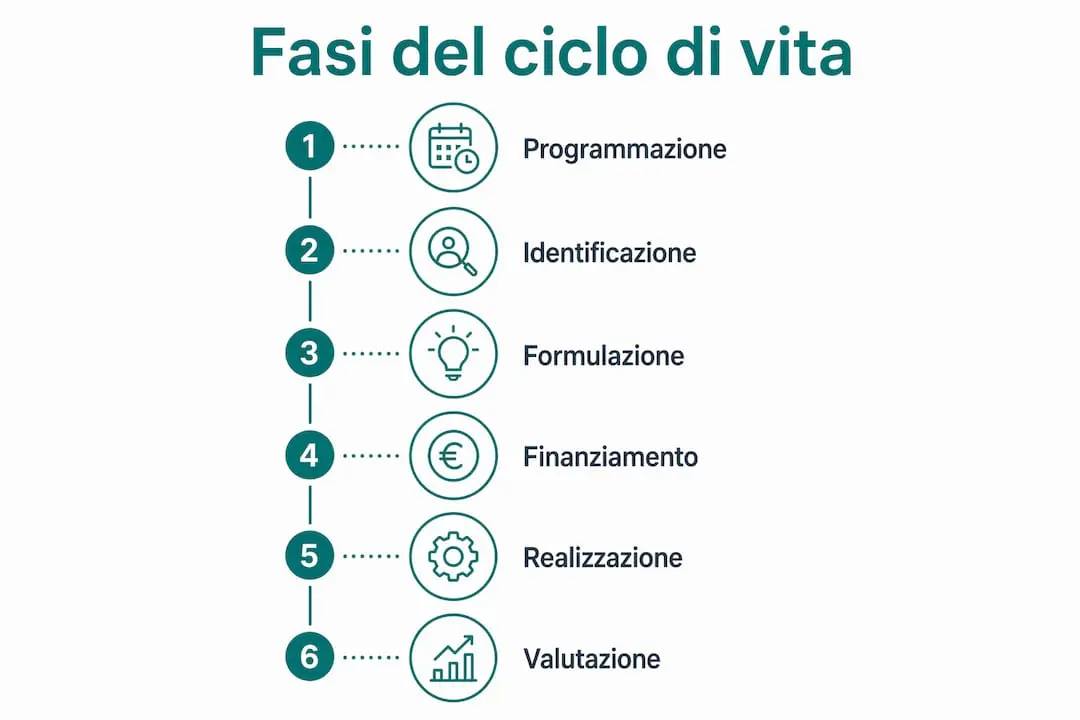
| Phase | Main objective | Expected output |
|---|---|---|
| Programming | Define the context and priorities | Strategic reference framework |
| Identification | Analyze needs and feasibility | Preliminary project proposal |
| Formulation | Structure objectives and operational plan | Detailed project plan |
| Financing | Secure the necessary resources | Approved budget and contracts |
| Realization | Perform scheduled tasks | Deliverable and verifiable progress |
| Evaluation | Measure results and learn | Final report and lessons learned |
Programming and identification
The planning phase establishes the context in which the project fits. It's not about planning activities, but about understanding which strategic priorities the project must serve. The identification phase translates these priorities into a concrete proposal, analyzing real needs and operational feasibility.
Formulation and financing
The formulation is the most technical phase: the operational plan is built, the KPIs are defined and the intervention logic is structured. Financing is not just about raising funds, but verifying that the available resources are consistent with the declared objectives.
Implementation and evaluation
Realization is the visible phase, but its success depends on the quality of the previous phases. The final evaluation does not simply close the project: it produces lessons learned that improve subsequent cycles.
A tip: Document key decisions during the formulation phase, not after the fact. Reconstructing the reasons for a choice after six months is almost impossible and makes any final evaluation useless.
How does PCM improve control, planning and margins?
PCM transforms a project into a measurable process, with clear objectives, defined responsibilities and constant visibility on time, costs and progress. This is not an abstract advantage: for a contract company, the difference between a monitored project and a non-monitored one is measured directly in the operating margin.
The concrete benefits of continuous control in PCM include:
- Monitoring of deviations: systematic comparison between planned and actual on times and costs, with early warning of risks.
- Marginality control: periodic verification that actual costs do not erode the margin expected in the offer phase.
- Resource management: Dynamic allocation based on actual progress, not static estimates.
- Verifiable quality: each phase produces measurable outputs that allow corrections before problems become critical.
- Structured lessons learned: Integrating past experience into subsequent cycles reduces recurring errors and improves future estimates.
A common mistake in operations teams is confusing the ends of strategic objectives with the means of day-to-day activities. PCM maintains this distinction explicitly, assigning each phase an expected outcome and not just a list of tasks to complete.
A tip: Define at least three marginality KPIs before starting implementation. Without predefined indicators, economic monitoring becomes a post-mortem analysis instead of an active management tool.
The economic sustainability of the project depends on the ability to intervene in real time. A monitoring system that produces data two weeks late is not a control system: it is a historical archive. PCM requires continuous visibility, not periodic reporting.
What techniques and tools do PCM support?
The most effective project management techniques in the context of PCM combine milestone planning, risk management and structured phase reviews. Milestone planning divides the project into verifiable checkpoints, making each progress measurable and not subjective.
Digital management platforms integrate planning, execution and control with real-time monitoring of time and costs. This changes the role of the project manager: from coordinator of meetings to manager of data and evidence-based decisions.
Key features to look for in a digital PCM tool are:
- Visual planning with Gantt and task dependencies
- Tracking actual costs against the phase budget
- Progress dashboards accessible to all stakeholders
- Integrated document management for each phase of the cycle
- Support for phase reviews with structured checklists
For the teams they managecomplex hardware projects, real-time visibility is especially critical: delays in physical projects accumulate quickly and are difficult to recover from without early signals.
A tip: Adopt digital tools progressively. Start with planning and cost tracking, then add advanced features. A team that adopts everything together tends to use nothing effectively.
Integration with existing business workflows, such as cost accounting or ERP systems, multiplies the value of the tool. Project data and financial data must speak the same language to produce reliable profitability analyses. For those who manage the digital governance of IT projects, a solid onecorporate identity managementit is the prerequisite for ensuring secure and traceable access to project management platforms.
How does PCM adapt to different company realities?
The PCM is not a rigid model. Its structure adapts to very different contexts, from manufacturing SMEs to research and development teams, keeping the underlying logic unchanged: each project must have measurable objectives, verifiable phases and a learning mechanism between one cycle and the next.
To apply it successfully in different contexts, it is best to follow these steps:
- Analyze the real operating context: a project isolated from its context is unlikely to be successful. An integrated vision of operating conditions, available resources and external constraints is needed.
- Calibrate the complexity of the phases: an SME with three people in the team does not need the same artifacts as a ten million euro European program. Simplify without eliminating control points.
- Define clear roles for each phase: In small teams, one person can fill multiple roles, but each responsibility must be explicitly assigned before startup.
- Build an archive of lessons learned: the PCM creates a virtuous cycle only if the experience of one project fuels the next. Without a structured archive, every project starts from scratch.
- Review the model after each cycle: The PCM is not a one-time document. It must be updated based on what worked and what didn't work.
PCM is particularly effective in SMEs and contract companies, where monitoring times, costs and margins is critical for sustainability. In these contexts, the PCM structure compensates for the lack of resources dedicated to project management, making control accessible even to operational teams without specialized training.
A tip: In SMEs, the greatest risk is skipping the evaluation phase because "the project is finished and there is already the next one". Spend at least two hours on the formal closing – it produces more value than any kickoff meeting.
Does PCM really work? My direct experience
I have been working with project teams for years and the thing that strikes me most is not when the PCM fails, but when it fails for the same reason: you plan by activity and forget the objective. I have seen 100% technically completed projects that produced nothing useful for the client. Every activity had been performed, every deliverable delivered, but the strategic objective had remained intact.
The PCM solves this problem only if it is applied with intellectual honesty. The evaluation phase does not serve to justify what has been done: it serves to understand if it worked. This distinction is inconvenient, but it is the only one that produces real learning.
Integration with advanced digital tools has changed the quality of control that can be exercised. With theartificial intelligence in project management, it is now possible to detect risk signals weeks before they become visible problems. This doesn't replace the manager's judgment, but it makes him or her much more informed.
The real challenge is not technical. It's cultural: convincing a team that documenting decisions and measuring results is not bureaucracy, but the only way to improve over time.
— Vinicio
ControlRoom and project lifecycle management
ControlRoom is Viniciolupo's platform designed to support the lifecycle management of complex projects, with features covering real-time planning, execution and monitoring. It integrates visibility into time, costs and progress in a single working environment, reducing the dispersion of information between different tools.
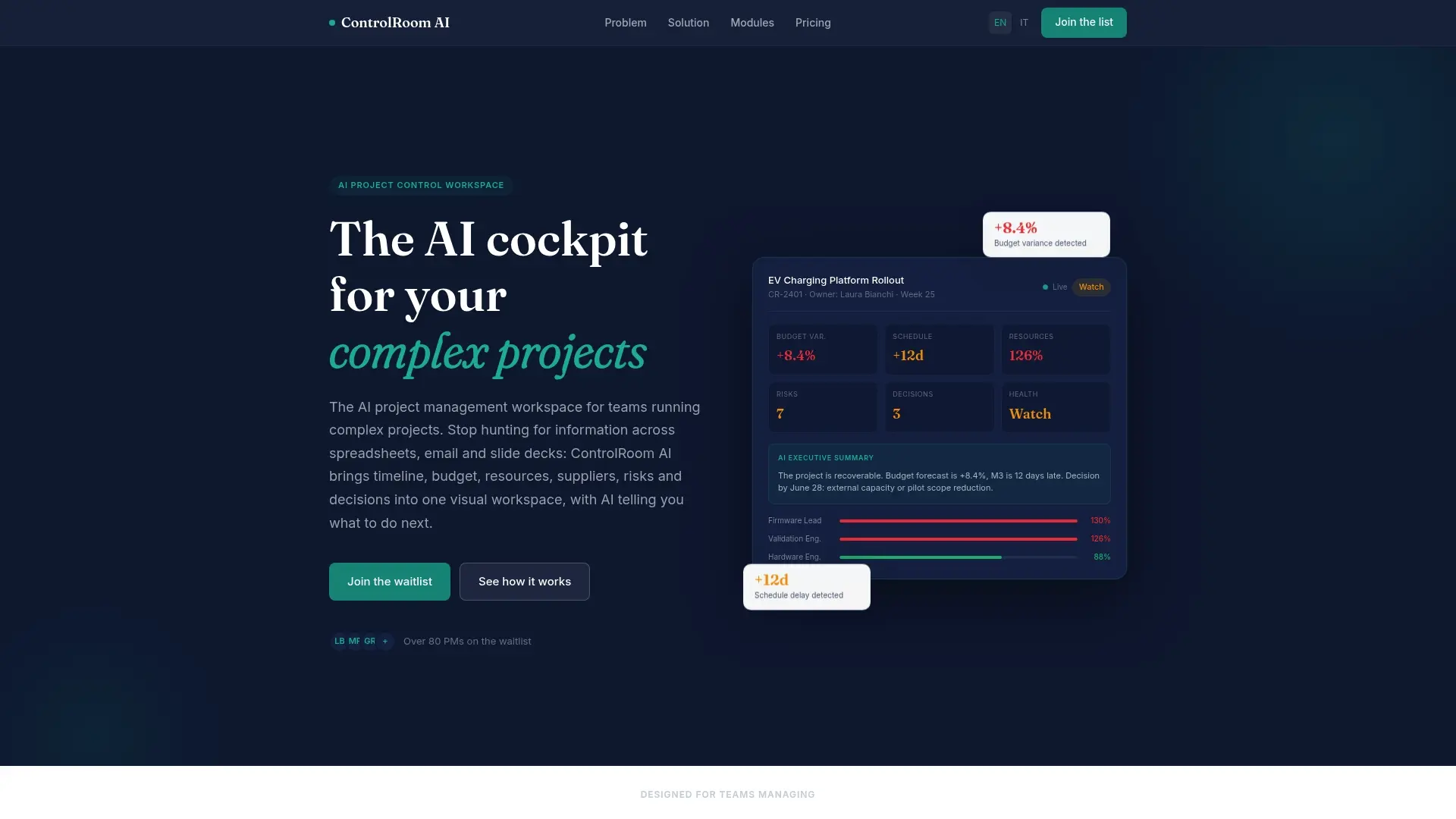
For teams managing contract projects or R&D programs, ControlRoom offers control dashboards, margin tracking and phase review support. IControlRoom use casesshow how teams from different industries applied the PCM framework with the support of the platform, achieving greater predictability and control over outcomes. Those who want to learn more can also explore theControlRoom main pagefor a complete overview of the available features.
Key points
Project Cycle Management transforms project management from sporadic activities to measurable processes, linking each phase to verifiable objectives and each cycle to the experience of the previous one.
| Point | Details |
|---|---|
| Definition of PCM | PCM divides the project into logical, interconnected phases to ensure control and reduce improvisation. |
| Life cycle stages | The six phases (planning, identification, formulation, financing, implementation, evaluation) produce measurable outputs. |
| Marginality control | Continuous monitoring of times and costs allows us to intervene before deviations erode the margin. |
| Structured lessons learned | Documenting the experience of each cycle reduces recurring errors and improves estimates in subsequent projects. |
| Adaptability to SMEs | The PCM scales to the size of the team, maintaining essential control points even in contexts with limited resources. |
Frequently asked questions
What is project lifecycle management in summary?
Project lifecycle management, known as Project Cycle Management (PCM), is the methodology that structures a project into logical and interconnected phases, from the definition of objectives to the final evaluation, ensuring continuous control over times, costs and results.
How many phases does the life cycle of a project have according to the PCM?
PCM generally involves six phases: planning, identification, formulation, financing, implementation and evaluation. Each phase has defined objectives, activities and outputs.
What is the difference between managing tasks and managing by objectives?
Activity-based management means completing tasks without checking whether they produce the expected results. PCM imposes objective logic: each phase is evaluated based on measurable results, not the number of activities completed.
Is PCM also suitable for small businesses?
PCM is particularly effective in SMEs and contract companies, where control of times, costs and margins is critical. The structure simplifies based on team size, but the essential checkpoints remain the same.
How are lessons learned integrated into PCM?
The lessons learned are collected during the evaluation phase and are archived in a structured way to feed into the planning of the next cycle. This mechanism creates a continuous improvement process that reduces recurring errors over time.