

Process optimization is the systematic improvement of business operations to increase efficiency, reduce costs and improve the quality of results. This is not a fixed-term project, but a continuous cycle of analysis, intervention and measurement. Techniques such as Process Mining, the Lean Six Sigma methodology and PDCA today constitute the standard reference in the sector. One2026 study showeda 30% reduction in operational handling times thanks to targeted interventions. Specific KPIs linked to business objectives are the main tool for measuring whether improvements produce concrete results.
What is process optimization: four fundamental steps
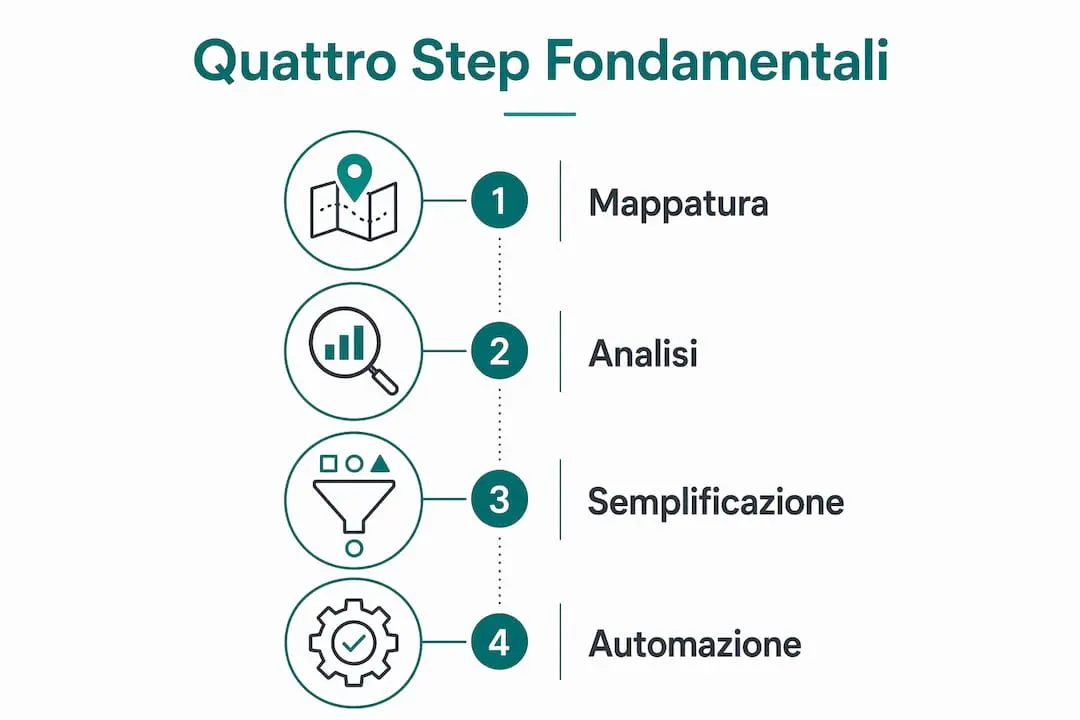
A structured process improvement path follows four distinct phases. Skipping even one compromises the entire result.
-
Real mapping of current processes.Mapping must reflect what actually happens, not what the manuals describe. Tools such as Process Mining allow you to visualize real flows starting from system data, eliminating the distortions of subjective perception.
-
Identification of waste and inefficiencies.Once the process has been mapped, bottlenecks, redundant steps and low value-added activities are identified. The Lean Six Sigma methodology classifies this waste into precise categories: overproduction, waiting, unnecessary transportation, defects and excessive inventories.
-
Redesign of flows and assignment of responsibilities.Redesign doesn't mean adding technology: it means simplifying the operational logic first. Each activity must have a clear manager and a measurable output. Awell designed flowguarantees decision-making autonomy without bureaucratic slowdowns.
-
Continuous monitoring via KPI.KPIs transform intentions into data. Without an active measurement system, any improvement tends to degrade over time. Operational governance integrates clear KPIs withdefined roles, reducing executive chaos.
The active involvement of the team and leadership is not an accessory element: it is the condition that determines whether the change holds up over time.
A tip: Host 1–2 hour collaborative workshops with operations managers. These short meetings accelerate priority identification and produce a shared action plan much faster than any analysis conducted in isolation.

What techniques and technologies support process improvement?
The internationally recognized methodologies for improving processes are divided into two categories: those oriented towards reducing waste and those oriented towards statistical quality.
- Lean Six Sigma:combines waste reduction (Lean) with statistical control of variability (Six Sigma). It is the most widespread methodology in manufacturing and service companies.
- Kaizen:aims at incremental and continuous improvement, directly involving operators. It works best in contexts where staff have direct visibility into processes.
- PDCA (Plan-Do-Check-Act):iterative cycle suitable for any type of process. It is the methodological basis of ISO 9001 and many quality management systems.
- Service Blueprint:visual tool for mapping processes that cross multiple departments, useful for identifying points of friction between different functions.
On the technological front, the current panorama offers tools with very different impacts depending on the digital maturity of the organization.
| Technology | Main function | Ideal context |
|---|---|---|
| Process Mining | View real streams from system logs | Companies with active ERP or CRM |
| RPA (Robotic Process Automation) | Automate repetitive and structured tasks | High volume, low variability processes |
| Integrated ERP | Eliminate redundancies and centralize data | Growing SMEs with fragmented processes |
| KPI dashboard | Monitor performance in real time | Any context with structured data |
The adoption ofIntegrated ERP and CRM toolseliminates redundancies and improves operational coordination between functions. Choosing the right technology always depends on the complexity of the process and the organization's ability to manage change. They existover 15 classified techniquesof improvement available depending on the business context. This number indicates that there is no one-size-fits-all approach: selection requires a preliminary assessment of specific priorities.
To delve deeper into the concrete application of these technologies, Viniciolupo collects practical resources onAI tools for processesand automation.
What are the most common implementation errors?
Cultural resistance is the main cause of failure of process improvement projects. It's not a technical problem: it's a people problem.
- Automate before simplifying.Bringing technology to an inefficient process doesn't make it better: it makes it inefficient faster. Logical simplification must precede any automation.
- Analysis without action.Many organizations produce detailed maps and accurate reports, then fail to transform these analyzes into concrete interventions.The real valuelies in the transformation of analyzes into measurable actions.
- Lack of clear responsibilities.When no one is formally responsible for a process, no one improves it. Each redesigned flow must have an owner with explicit mandate.
- Exclude operational personnel.The lack of active employee involvement severely limits the effectiveness of the intervention, even with advanced software. Those who work on the process every day know the inefficiencies better than any external consultant.
- Absence of visible leadership.Without active leadership patronage, improvement projects lose priority at the first operational hurdle.
Optimization is a culture of continuous improvement, not a project with an end date. This distinction radically changes the way an organization approaches each individual intervention.
A tip: Focus on “quick wins”: select a critical process with visible impact and solve a specific problem within 30–60 days. The tangible result creates confidence in the method and reduces resistance to change in subsequent stages.
To learn more about the most frequent pitfalls indigital process management, industry resources offer up-to-date analysis on typical errors in implementing automation and digital tools.
How to monitor business processes over time?
Continuous monitoring is the phase that distinguishes an organization that improves from one that returns to old habits after six months.
-
Define KPIs linked to business objectives.A generic KPI like “average process time” is not enough. We need an indicator that answers a specific question: how long does it take to approve an order? How many errors does the billing process produce each month?
-
Build readable dashboards.Data must be accessible to operational decision makers, not just analysts. An effective dashboard displays three or four key metrics with clear trends, not thirty overlaying graphs.
-
Establish a review pace.The monthly cadence works for most operational processes. The quarterly review is used to evaluate whether the strategic objectives are still aligned with the results.
-
Transforming data into decisions.Data without interpretation is noise. Each review session must end with at least one concrete decision: change a parameter, assign a responsibility, start a new improvement cycle.
| KPIs | What it measures | Revision frequency |
|---|---|---|
| Process cycle time | End-to-end execution speed | Weekly or monthly |
| Error rate | Output quality | Monthly |
| Cost per transaction | Economic efficiency | Quarterly |
| Customer satisfaction | External impact of the process | Monthly or quarterly |
Internal communication of results is often underestimated. Sharing progress with the team that contributed to the improvement keeps motivation high and consolidates the culture of continuous change.
Key points
Process optimization requires real mapping, simplification before automation, specific KPIs and leadership that sustains change over time.
| Point | Details |
|---|---|
| Real mapping | Start from system data, not from manuals, to see real flows. |
| Simplify before automating | Bringing technology to an inefficient process makes it worse, not solves it. |
| KPIs linked to objectives | Each indicator must answer a specific and measurable business question. |
| Staff involvement | Those who work on the process know the inefficiencies: excluding it is the most costly mistake. |
| Culture of continuous improvement | Optimization does not end with the project: it requires governance and periodic review. |
What I learned from working on processes
The most common temptation I see in technical and managerial teams is to start with technology. You buy software, you set up a dashboard, you start an RPA project. Then, after a few months, the results don't arrive and the blame is placed on the wrong tool.
The problem is almost never the instrument. It's that no one has previously clarified what the process must produce, who is responsible for it and how success is measured.
Focus the initial improvementon just one critical process allows you to obtain tangible results quickly. This approach is not a shortcut: it is the most effective strategy for building the internal credibility needed to scale change.
AI Process Intelligence, like the one available onViniciolupo, changes the quality of decisions because it brings objective data where previously there was only perception. But the rule applies here too: first the operational logic is clarified, then artificial intelligence is brought in to support it.
Company culture remains the factor that determines whether improvements last. A team that understands why a process is changing is ten times more effective than one that is simply told what to do.
— Vinicio
Advanced process management with the support of AI
Those who work on complex projects know that the distance between a well-done analysis and effective execution is often the critical point.
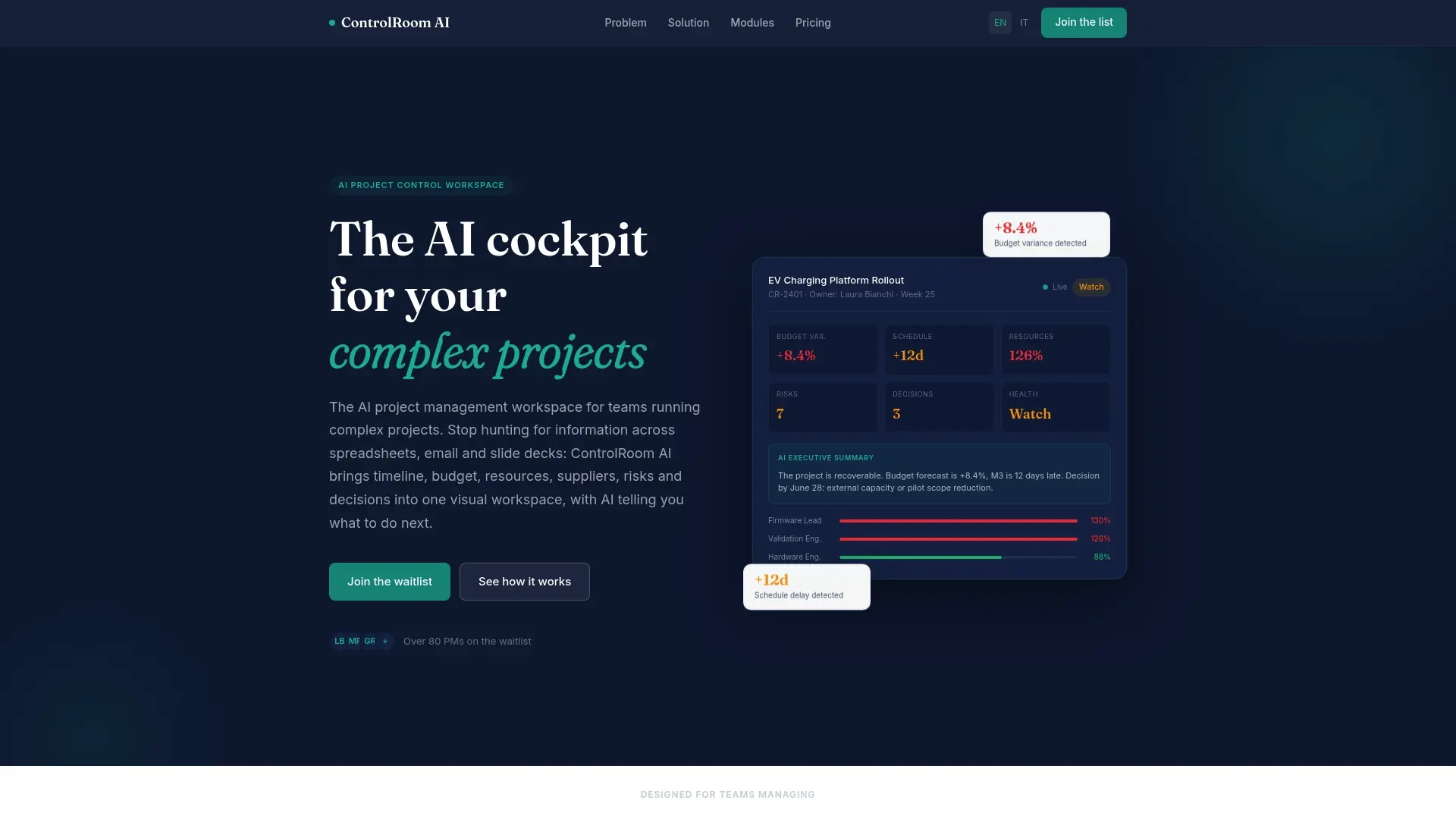
Viniciolupo has developedControlRoom AI, a workspace for managing complex projects with the support of artificial intelligence. The tool integrates process visibility, decision tracking and KPI monitoring into a single operational environment. For technical teams and managers managing R&D or operational transformation projects, this means less time spent gathering information and more time spent making decisions that matter. Those who want to evaluate their digital maturity before starting a project can use theProcess Readiness Toolto obtain a quick and structured evaluation.
Frequently asked questions
What is process optimization in brief?
Process optimization is the systematic improvement of company activities to increase efficiency, reduce costs and improve the quality of outputs. It is based on mapping, analysis of inefficiencies and continuous monitoring via KPIs.
What is the difference between Lean and Six Sigma?
Lean reduces waste and accelerates flows; Six Sigma reduces the statistical variability of outputs. Lean Six Sigma combines both approaches into a single structured methodology.
When is it best to use Process Mining?
Process Mining is useful when the company already has an active ERP or CRM and wants to visualize real flows starting from system logs, without relying on subjective descriptions of the processes.
Why do many optimization projects fail?
The main cause is the lack of involvement of operational staff and the absence of visible leadership. Automating a process without first simplifying it is the second most frequent mistake.
How often should process KPIs be reviewed?
The monthly review is adequate for most operational processes. The quarterly review is used to verify alignment with the strategic objectives of the organization.