

AI project management is the application of artificial intelligence algorithms and technologies to plan, execute and control complex projects, increasing the accuracy of estimates, automating repetitive tasks and enhancing strategic decisions. In the research and development sector, this discipline, also known asAI project management, radically changes the way Italian teams deal with deadlines, budgets and risks. The European regulatory framework, with EU Regulation 2024/1689 (EU AI Act), now adds precise compliance obligations that every project manager must know. Ignoring this evolution is not an option: those who manage projects with analogue methods risk losing competitiveness compared to teams that already integrate AI into their processes.
What is AI project management and how is it divided into levels
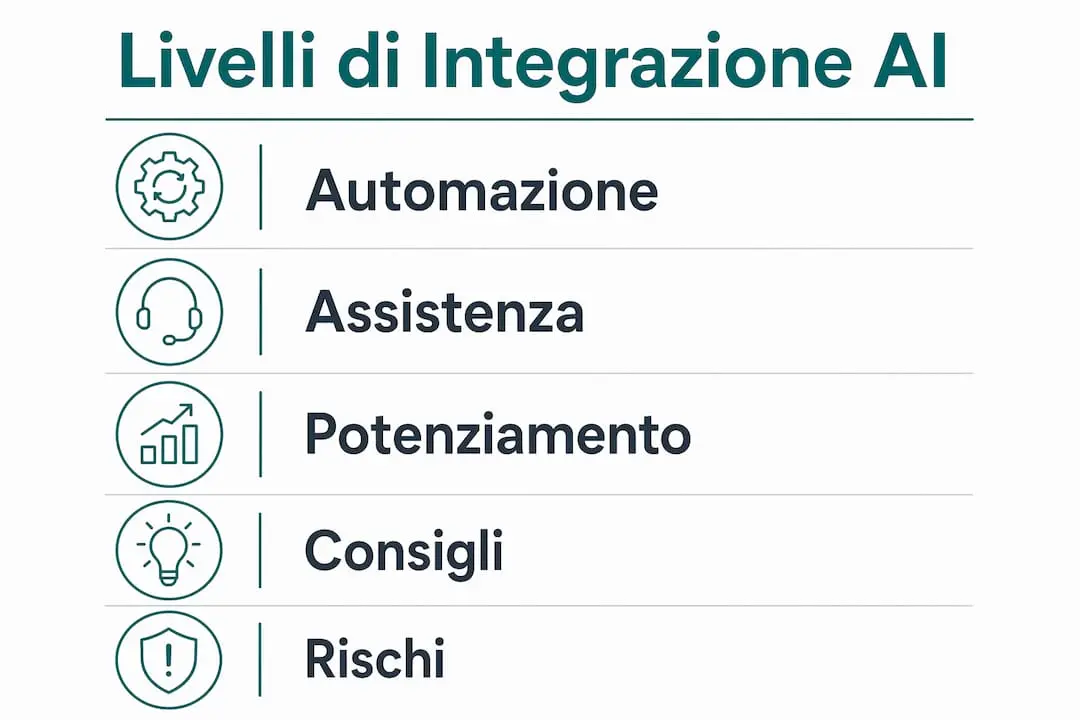
AI project management is not a single tool, but a continuum of integration that goes from basic automation to advanced cognitive support. Understanding the three levels of integration helps you choose where to intervene first and with what expected impact.
Level 1: Automation of repetitive tasks.AI handles low-risk, high-volume tasks, such as updating progress statuses, generating standardized reports and automatically scheduling reminders. This level is the safest entry point for any team. Theautomation via AItargets the bureaucratic workload, which in complex projects can absorb up to 30–40% of a project manager's time according to that source. How much of it is actually recovered depends on the team and has not been measured here; the hours freed up can go to high-value activities: analysis, relations with stakeholders, policy decisions.
Level 2: assistance in decision-making processes.AI analyzes project data in real time and suggests corrective actions, resource reallocations or plan adjustments. He doesn't decide: he proposes. The project manager evaluates and approves. This level requires quality data and a minimum of digital maturity in the team.
Level 3: cognitive enhancement.AI processes complex scenarios, simulates risks, compares strategic alternatives and synthesizes information from heterogeneous sources. Themachine learning algorithmsanalyze historical data to provide intelligent planning, automatic transcriptions and real-time dashboards. At this level, the value is greatest but the dependence on data quality and human supervision is also highest.

A tip: Before moving up to level 3, verify that your historical project data is structured, complete and accessible. An AI model trained on incomplete data produces unreliable estimates.
The risk that cuts across all three levels is excessive delegation.AI excelsin tasks with low decision-making weight and high volume of data, but critical decisions remain human responsibilities. This is not a temporary limitation of the technology: it is a conscious governance choice.
How AI improves planning, control and risk management
The most measurable impact of AI project management focuses on three areas: predictive planning, continuous monitoring and project risk management.
Predictive planning and accurate estimates
Machine learning models build duration and cost estimates by analyzing historical data from similar projects. This overcomes the limit of estimates based on the subjective experience of the individual PM, which tends to underestimate the complexity in R&D projects. Dynamic planning automatically updates the plan when input variables change, without requiring manual realignment sessions.
Early warning system and risk monitoring
An AI-based early warning system continuously monitors project indicators and flags deviations before they become critical. This is particularly useful for managing common risks in innovation projects, where technical uncertainties add to market ones.Many companies deal with risk managementas a formal exercise, without integrating risks at a strategic level, creating information silos and misaligned decisions. AI breaks down these silos by aggregating signals from different sources into a single, coherent view.
Automation of reporting and meeting summaries
The automatic generation of status reports, the transcription of meetings and the summary of action items are among the most immediate and high-return applications. An R&D team that eliminates manual reporting frees up time for technical analysis, which is the high-value work that no algorithm can replace.
| Application area | Main benefit | Required maturity level |
|---|---|---|
| Predictive planning | More accurate time and cost estimates | Medium |
| Early warning system | Anticipate critical issues before they arise | Medium-high |
| Reporting automation | Reduces the PM's bureaucratic burden | Low |
| Risk scenario analysis | Supports complex strategic decisions | High |
Managing the project budget with AI also means having real-time visibility on the deviations between the final balance and the estimate, with automatic alerts when the defined thresholds are exceeded. This reduces surprises at the end of the sprint or at the end of the phase.
What are the regulatory and governance challenges in 2026?
EU Regulation 2024/1689, known as the EU AI Act, came into force with progressive obligations. Under the Digital Omnibus on AI, the high-risk obligations for the Annex III areas (for example employment) have been deferred to 2 December 2027, so check the dates in the current text before planning. For teams managing AI projects, compliance is not an abstract legal issue: it is a concrete operational responsibility.
The regulation classifies AI systems by risk level: unacceptable, high, transparency-related and minimal. Three of these levels matter most for project teams:
- Minimum risk:systems that automate administrative tasks without impacting people or critical decisions. No specific obligations beyond good practices.
- High risk:systems that fall under the criteria of Article 6 and Annexes I and III (for example certain uses in employment or critical infrastructure), subject to the exemptions in the Act. They require detailed technical documentation, compliance records, robustness testing and continuous monitoring.
- Unacceptable risk:prohibited systems, such as those that manipulate behavior or perform social profiling.
The AI Act sets obligations by risk level, mainly for providers and deployers of AI systems; high-risk systems require, among other things, detailed technical documentation. See the European Commission overview.
Technical project governance, in this context, may include assigning someone to oversee AI compliance (an organisational choice), the definition of audit procedures and data management according to the GDPR. For R&D teams developing or integrating AI models into their projects, the risk of misclassification is real. Whether a system is high-risk depends on its intended use and on the criteria of Article 6 and Annexes I and III, including the exemptions in Article 6(3); the amount of resources a decision involves is not, in itself, the test.
The practical implications forsecurity of AI projectsthey also include managing access to training data, tracking automated decisions, and the ability to explain AI results to non-technical stakeholders. Multi-stakeholder governance, involving legal, IT, operations and management, is not a luxury: it is the minimum structure for operating responsibly.
How does the role of the project manager change with AI?
The project manager who integrates AI into his projects is no longer a Gantt plan executor. It becomes an intelligent orchestrator that defines objectives, interprets AI outputs and makes decisions that algorithms cannot make. This change is already underway:those who do not adapt their roleAI skills risk obsolescence, while the professionals trained become intelligent orchestrators.
The skills required in 2026 are divided into four dimensions:
- Prompt engineering applied to projects:knowing how to formulate precise and contextualized requests to the AI to obtain useful outputs. A generic prompt produces generic responses. A prompt that includes project context, constraints, and expected format produces a workable preliminary version.
- Project memory management:build and maintain a private knowledge base of the project, which can be queried by AI using RAG (Retrieval-Augmented Generation) techniques. Successful use of AI in projects depends on building private project memories that query specific business data.
- Critical validation of AI outputs:every AI output is a preliminary version, not a decision. The PM must have the technical skills to evaluate the plausibility of estimates, identify hallucinations, and correct errors before they enter the official plan.
- Certified training on AI-specific methodologies:frameworks like PMI-CPMAI™ are designed to handle the iterative and probabilistic nature of AI projects, which differs structurally from traditional linear software projects. Ispecific frameworks such as CPMAIthey are necessary to manage the iterative and uncertain nature of AI projects compared to traditional linear software projects.
A tip: Start with a low-complexity pilot to build project memory and test prompts. The results of the pilot become the internal case study that convinces management to broaden adoption.
What best practices should we adopt to integrate AI into corporate projects?
The adoption of AI in project management almost always fails for organizational, not technological, reasons. Dirty data, internal resistance and the absence of a gradual integration strategy are the most common mistakes in planning innovation projects.
The best practices that produce concrete results follow a precise logic:
- Data first:Before introducing any AI tool, verify that historical project data is structured, complete, and accessible in a machine-readable format. An AI system fed by unstructured Excel sheets produces unreliable output.
- Gradual integration at three levels:start by automating repetitive tasks, consolidate the results, then go to the next level. Forging ahead leads to superficial adoptions that are abandoned after the first failures.
- Calculation of ROI before investment:define measurable metrics before adopting a tool. Hours saved per PM, reduction in budget variances, number of risks identified in advance. Without baseline, you cannot demonstrate the value of the investment.
- Change management:internal resistance is predictable and manageable. Involve senior PMs in the tool selection phase. Those who participate in the choice adopt the solution more easily.
- Legacy system governance:the integration between AI tools and existing systems (ERP, CRM, document repositories) requires a specific technical plan. Poorly designed integration creates data duplication and operational confusion.
For R&D teams, theinsights into automation via AIshow that the most effective applications combine process automation with predictive analytics, not treat them as separate initiatives.
Key points
AI project management requires gradual integration, regulatory governance and a project manager who knows how to orchestrate algorithms and human decisions with method and responsibility.
| Point | Details |
|---|---|
| Three levels of integration | Start with automation, consolidate, then move on to decision-making assistance and cognitive enhancement. |
| Compliance EU AI Act 2024/1689 | Categorize the risk of your AI systems and prepare technical documentation for those at high risk. |
| PM's role as orchestrator | Train the team on prompt engineering, RAG and critical validation of AI outputs. |
| Quality data as a prerequisite | Structure historical project data before introducing any AI tools. |
| Measurable ROI | Define baseline metrics before adoption to demonstrate the value of the investment. |
My vision on AI project management in Italy
Two opposite attitudes can stall AI adoption in an R&D team: uncritical enthusiasm and paralyzing distrust. Both lead to the same result: no real change.
A mistake to avoid is treating AI as a standalone solution: you buy a tool, expect results, and get disappointed. The truth is that AI amplifies what already exists in the team: if processes are messy, AI produces chaos faster. If the data is reliable and the PM knows what to ask for, AI produces real value.
The Italian context adds a specific variable: regulatory compliance is often perceived as a bureaucratic obstacle rather than a quality framework. Those who integrate AI governance from the beginning build a competitive advantage, not a cost. Teams that document their AI systems today will be ready for international audits and partnerships tomorrow.
Continuing education is non-negotiable. The PMI-CPMAI™ is a starting point, but true expertise is built in the field, with real projects, documented errors and rapid iterations. I advise every R&D manager to dedicate at least one pilot project per year to exploring new AI applications, with clear metrics and critical review of the results.
— Vinicio
Viniciolupo ControlRoom: the AI workspace for complex projects
R&D teams that want to move from theory to practice need a tool built for the real complexity of projects, not simplified use cases.
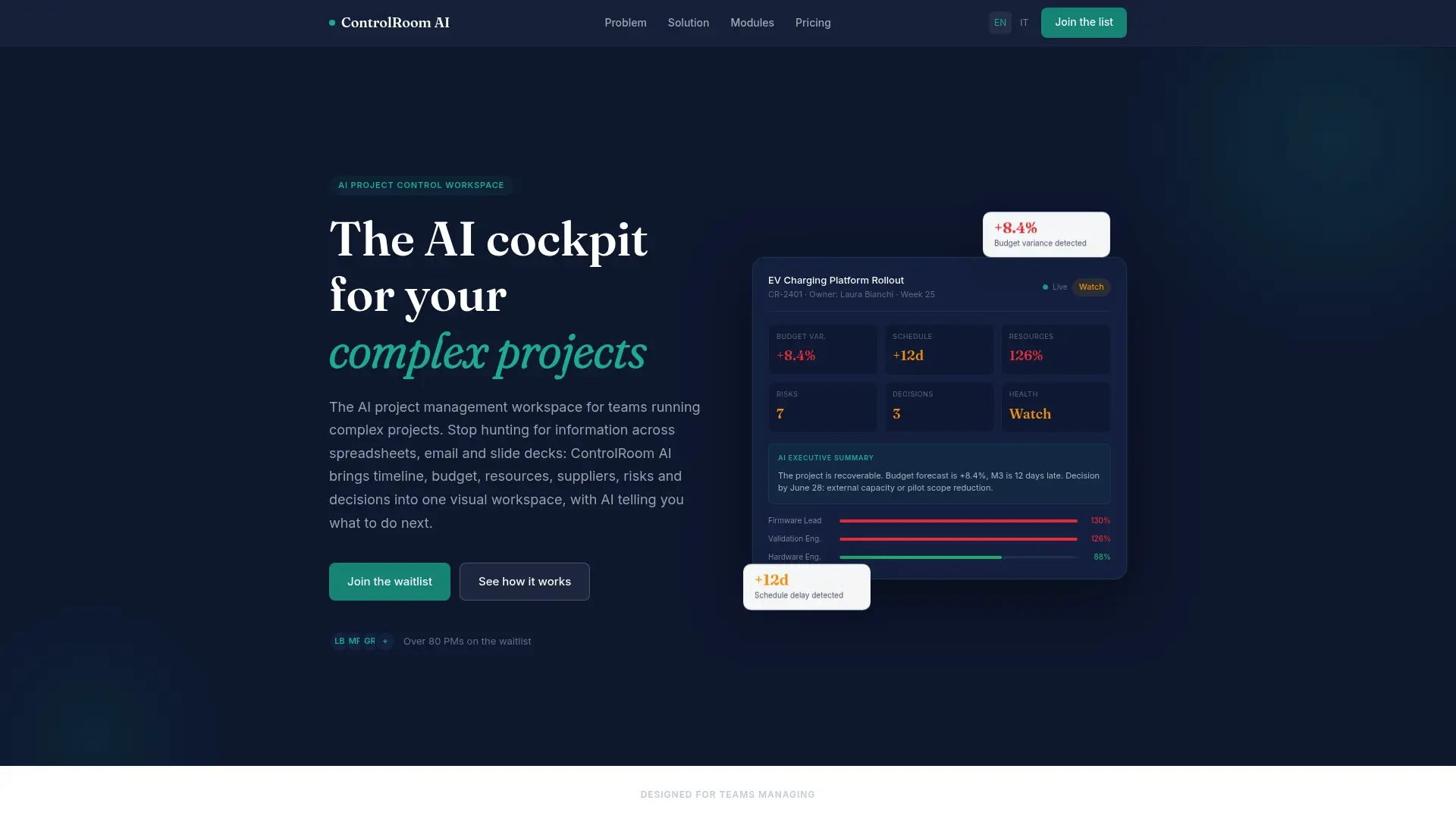
ControlRoom AIis the Viniciolupo workspace designed for the management of complex projects, built to help connect plan, costs and issues in one view. For teams managing multiple projects in parallel, centralized visibility can support coordination and decisions; no measured effect is claimed here. To see it with synthetic data, request access through the demo form. Those who want to evaluate specific use cases for their context will find a collection in the sectionControlRoom use cases. For those who are still in the exploratory phase, Viniciolupo also offers a selection offree toolsto start experimenting with the automation of project processes without initial investment.
Frequently asked questions
What is AI project management in a nutshell?
AI project management is the use of artificial intelligence algorithms to plan, monitor and control projects, automating repetitive tasks and supporting the project manager's strategic decisions.
What is risk management in AI projects?
Risk management in AI projects is the process of identifying, classifying and continuously monitoring risks, enhanced by early warning systems that analyze real-time data to anticipate critical issues before they arise.
What skills are needed to manage business projects with AI?
Key skills include prompt engineering, project memory management via RAG, critical validation of AI outputs, and knowledge of certified frameworks such as PMI-CPMAI™ for iterative projects.
What is technical project governance in the AI field?
The technical governance of the AI project is the set of procedures, responsibilities and controls that guarantee regulatory compliance, data quality and traceability of automated decisions, in line with EU Regulation 2024/1689.
Does AI replace the project manager?
No. AI supports the project manager by automating low-value tasks and providing predictive analytics, but responsibility for critical decisions remains human. The role evolves from executor to intelligent orchestrator.