

The RACI matrix is the most effective tool for defining roles and responsibilities within a technical team. RACI is the acronym for Responsible, Accountable, Consulted and Informed: four roles that cover every aspect of managing activities in a project. For team leaders and managers of R&D projects, creating a technical team responsibility matrix is not a bureaucratic exercise. It is the operational basis that separates projects that are progressing from those that are stuck on who should do what. Thelack of clarity in rolesit is the primary cause of stalls and inefficiencies in R&D projects.
How to create a responsibility matrix for your technical team
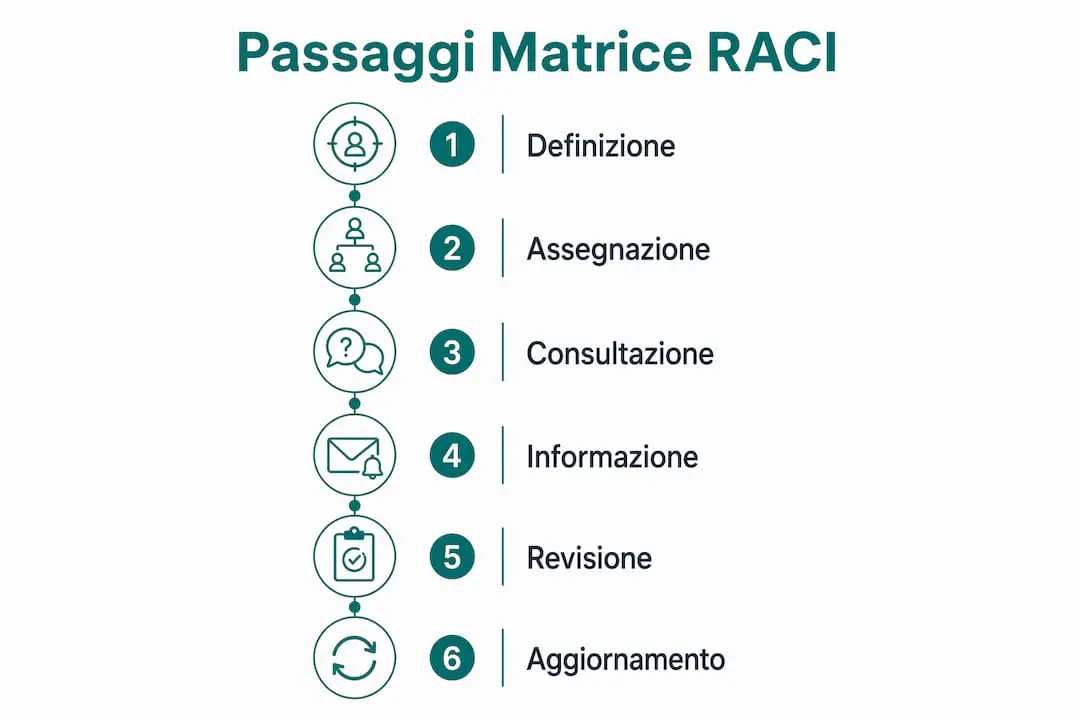
Building an effective RACI matrix requires method, not just an Excel table. The process starts from the identification of the key activities of the project and ends with a shared review with the team. Following these steps reduces ambiguity from the first week on the job.
The six fundamental steps
-
List all project activities and deliverables.Start from the project plan and break down each phase into concrete activities. For an R&D project, this includes activities such as literature review, laboratory testing, technical report writing and presentations to stakeholders.
-
Identify functional roles, not people. Assign functional rolesinstead of proper names it keeps the matrix stable over time. If the laboratory manager changes, the matrix remains valid: just update whoever holds that role.
-
Assign only one Accountable for each activity.This is the most important rule. A single Accountable per activity eliminates decisional ambiguities. The Accountable is responsible for the final result and often coincides with the team leader or technical project manager.
-
Limit Consulted to a maximum of 2-3 people per activity.Each Consulted requires two-way communication before the business can progress. Too many Consulted create real, not perceived, bottlenecks.
-
Manage Informed with asynchronous communications.The Informed receive updates but do not block the process. Using email or automatic notifications from a project management system is sufficient for this group.
-
Review the matrix with the team before launching it.A 60-minute collective review session identifies overlaps, gaps and resistance before they become operational problems.
A tip: Use a shared digital template from day one. A matrix on paper or in a local file becomes obsolete in a few days. Integrating it into a project management system ensures that everyone sees the updated version in real time.
The following table shows an example of a team responsibility scheme for a typical R&D project:
| Activities | Responsible | Accountable | Consulted | Informed |
|---|---|---|---|---|
| Literature review | Junior researcher | R&D Manager | Domain expert | Direction |
| Laboratory tests | Laboratory technician | Technical manager | QA Engineer | Project manager |
| Technical report preparing | Senior engineer | Project manager | Legal representative | Stakeholders |
| Presentation of results | Project manager | R&D Director | Technical team | Investors |

What are the RACI roles in a technical team?
The four roles of the matrix have precise meanings and are not interchangeable. Confusing them is the most common mistake in technical teams approaching the matrix for the first time.
- Responsible ®:who does the work. In a technical team, this may be the lab technician, software engineer, or researcher assigned to the task. Each activity can have multiple Managers.
- Accountable (A):who is responsible for the result. The Accountable has ultimate responsibility and must be only one person per activity. In R&D projects, it often coincides with the technical manager or team leader.
- Consulted ©:who provides input before the task is completed. Communication is two-way. In the technical context, this can be a regulatory expert, a systems engineer or an external consultant.
- Informed (I):who receives updates afterwards. It doesn't block the process. Typically includes management, stakeholders and support departments.
Using functional roles instead of proper names is the choice that gives durability to the matrix. An R&D team changes composition during a multi-year project. The matrix must remain readable even after three people have left the team. Assigning «Technical Manager» instead of «Mario Rossi» solves the problem at its root.
The impact on management responsibility is direct. When every activity has a clear Accountable, decisions do not get stuck waiting for collective consensus. The team advances, and whoever has to answer for the result knows exactly what their perimeter is.
Common mistakes in managing technical responsibilities
The RACI matrix almost always fails for the same reasons. Knowing them in advance allows you to avoid them.
- More Accountable for the same activity.When two people are both Accountable, neither of them truly feels responsible. The result is mutual waiting and delays. The rule is absolute: only one Accountable per activity, without exceptions.
- Assignments based on names instead of roles.If the matrix says «Luca» instead of «QA Engineer», it becomes useless at the first personnel change. This mistake is common in small teams where people know each other well and there is a tendency to personalize everything.
- Too many Consulted. Limit Consulted meetings to a maximum of 2-3 peopleby task is a rule of thumb that prevents decision bottlenecks. Each additional Consulted adds a communication loop and a potential blocking point.
- Static matrix, never updated.A matrix filled out at the start of the project and then forgotten in a shared folder is of no use to anyone. The matrix loses effectiveness if it is not integrated into the daily workflow and revised with each significant change in the project.
- Ambiguity between Responsible and Accountable.Many teams use the two roles synonymously. I'm not. The Responsible executes, the Accountable responds. An engineer can be Responsible for ten activities and Accountable for none.
A tip: Schedule a matrix review every four weeks or at each project milestone. Make it a permanent item on the team agenda, not an optional activity.
The balanced distribution of responsibilities is equally important. Concentrating too many "A's" on a single role generates overload and slows down the entire project. Distributing the load realistically is an integral part of creating the matrix.
How the responsibility matrix relates to the 2026 regulations
The RACI matrix is not just a project management tool. In 2026, it has direct legal implications for Italian technical teams.
«The liability of the Legal Representative is not automatic by position: it requires concrete proof of actual fault, whether culpa in eligendo or culpa in vigilando.» The Supreme Court clarified this principle in 2026, confirming that a well-documented delegation protects the Legal Representative from unjustified liability.
This principle translates into practice:a matrix that clearly defines the Accountableit demonstrates that the delegation took place in a formal and verifiable manner. In case of dispute, the organization can prove that the technical responsibility was assigned to a specific person with appropriate skills.
From January 2, 2026,updated rules on the Technical Managerimpose stricter training requirements and mandatory exam sessions. This makes it even more necessary to formally document who holds the role of Technical Manager within the matrix. The nomination cannot be implicit or verbal.
| Legal risk | How the matrix reduces it |
|---|---|
| Automatic accountability by location | Defines the Accountable with documentary proof |
| Culpa in eligendo | It certifies that the role has been assigned to a competent person |
| Culpa in vigilando | Track periodic reviews and matrix updates |
| Undocumented delegation | Formalize the chain of responsibility for each activity |
The legal protection of the company therefore also passes through the quality of the RACI matrix. An updated document, signed and integrated into the project management system is worth much more than a generic internal policy. For teams operating in regulated industries, such as environmental management or industrial manufacturing, this is crucial.
Key points
The RACI matrix is the most effective tool for defining roles, preventing conflicts and legally protecting the technical team in complex R&D projects.
| Point | Details |
|---|---|
| Only one Accountable per activity | Assigning multiple Accountables generates mutual expectations and blocks decisions. |
| Functional roles, not names | Using roles instead of people keeps the matrix valid even when the team changes. |
| Limit Consulted | Maximum 2-3 Consulted per task prevents decision bottlenecks. |
| Matrix as a living document | Reviewing it every four weeks or at each milestone maintains its real effectiveness. |
| Legal value of the matrix | An updated matrix documents the delegation and protects the Legal Representative. |
My experience with the RACI matrix in technical teams
I've seen R&D teams resist the RACI matrix with the argument that it "slows down work." The opposite is true. Initial resistance lasts a week. The gain in clarity lasts for the life of the project.
The most common error I observe is not technical: it is cultural. Teams treat the matrix as a document to be filled out once and stored. The matrix only works if it becomes a living reference, consulted in progress meetings and updated at each change in scope. Integrate it into a Kanban system or management platformR&D decision managementit completely changes the result.
Another point that almost everyone underestimates: the matrix reduces interpersonal conflicts. When boundaries of responsibility are written and shared, arguments about “who was supposed to do what” disappear. The team stops wasting time in clarification meetings and gets back to work. This is the true return on investment of the RACI matrix.
— Vinicio
Viniciolupo and the management of the responsibility matrix in technical teams

Viniciolupo developed ControlRoom AI as an AI workspace designed for technical teams and R&D project managers managing complex responsibilities. The platform integrates the logic of the RACI matrix directly into workflows, making visible in real time who is Accountable for each activity and who must be involved in decisions. For teams working on projects with regulatory constraints or with distributed teams, centralized visibility makes the difference between a project that moves forward and one that stalls on every decision. You can exploreControlRoom AIto see how it fits into your tech team structure. They are also availablefree toolsto evaluate the readiness of the processes before structuring the matrix.
Frequently asked questions
What is the RACI matrix and what is it for?
The RACI matrix is a scheme that assigns four roles (Responsible, Accountable, Consulted, Informed) to each activity in a project. It serves to eliminate ambiguity about who executes, who decides and who needs to be informed.
How many Accountables can there be for each activity?
One and only one. Having multiple Accountables for the same activity generates decision-making confusion and inevitable delays.
How often should the matrix be updated?
The matrix should be reviewed every four weeks or at each significant project milestone. A static matrix quickly loses adherence to the reality of the project.
Does the RACI matrix have legal value in Italy in 2026?
Yes. An updated and documented matrix demonstrates the formal delegation of technical responsibilities and protects the Legal Representative from automatic liability by position, according to the 2026 Supreme Court jurisprudence.
How many Consulted is it correct to include per activity?
Maximum 2-3 Consulted per activity. Exceeding this number slows down the decision-making process and creates bottlenecks that impact the entire project.